CI/CD Pipelines That Don't Get in Your Way
How to design CI/CD pipelines that are fast, reliable and genuinely trusted by your team: caching, parallelism, environment parity and deploy strategies.
The Pipeline That Kills Productivity
A CI/CD pipeline that takes 25 minutes to run is not a safety net — it's a tax on every developer, every commit, every day. Slow pipelines get ignored. Green checks become rubber stamps. The pipeline stops protecting you.
This is how I think about building CI/CD systems that teams actually trust and use.
Principle 1: Speed Is a Feature
Target under 5 minutes for the feedback loop from push to test results. Here's how:
Cache Everything You Can
# GitHub Actions — aggressive dependency caching
- name: Cache node_modules
  uses: actions/cache@v4
  with:
    path: |
      ~/.npm
      node_modules
      .next/cache
    key: ${{ runner.os }}-node-${{ hashFiles('package-lock.json') }}
    restore-keys: |
      ${{ runner.os }}-node-

# Docker layer caching
- name: Build image
  uses: docker/build-push-action@v5
  with:
    context: .
    cache-from: type=gha
    cache-to: type=gha,mode=max
With proper caching, npm install drops from 3 minutes to 8 seconds on cache hits.
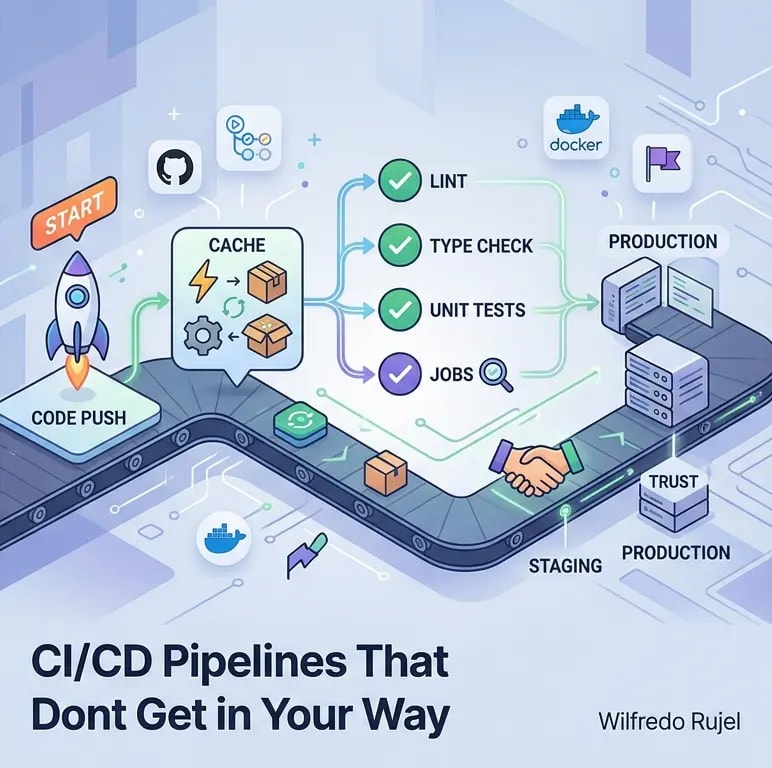
Parallelize Independent Jobs
jobs:
  lint:
    runs-on: ubuntu-latest
    steps: [checkout, setup-node, run-lint]

  type-check:
    runs-on: ubuntu-latest
    steps: [checkout, setup-node, run-tsc]

  unit-tests:
    runs-on: ubuntu-latest
    steps: [checkout, setup-node, run-jest]

  # Only run after all checks pass
  deploy:
    needs: [lint, type-check, unit-tests]
    if: github.ref == 'refs/heads/main'
    runs-on: ubuntu-latest
    steps: [deploy-to-staging]
Running lint, type-check, and tests in parallel cuts pipeline time by 60%.
Principle 2: Environment Parity
"Works on my machine" is a symptom of environment mismatch. Treat environment parity as a hard requirement.
# Pin exact tool versions everywhere
- uses: actions/setup-node@v4
  with:
    node-version-file: ".nvmrc" # Read from project file, not hardcoded

- uses: actions/setup-python@v5
  with:
python-version-file: ".python-version"# Development and CI use the same base image
FROM node:22.11.0-alpine AS base
# Deterministic installs
RUN npm ci --frozen-lockfile
# Match production exactly
ENV NODE_ENV=productionLock files, .nvmrc, .tool-versions, and pinned Docker image digests are the infrastructure for reproducible builds.
Principle 3: Fail Fast, Fail Clearly
Developers should know within 60 seconds if their push has an obvious error.
jobs:
  quick-checks:
    runs-on: ubuntu-latest
    steps:
      - uses: actions/checkout@v4

      # These run in seconds and catch 80% of failures
      - name: Check formatting
        run: npx prettier --check .

      - name: Type check
        run: npx tsc --noEmit

      - name: Lint
        run: npx eslint . --max-warnings 0

  # Run the slow tests only after quick checks pass
  integration-tests:
    needs: quick-checks
    runs-on: ubuntu-latest
    steps:
      - name: Run integration tests
        run: npm run test:integration
Order jobs by speed and likelihood of failure. The fastest, most informative check should run first.
Principle 4: Deployment Strategies
Never deploy directly to production. Use staged rollouts.
Blue-Green Deployments
#!/bin/bash
# Deploy to inactive slot, then swap
CURRENT=$(get_active_slot)  # "blue" or "green"
NEXT=$([ "$CURRENT" = "blue" ] && echo "green" || echo "blue")

# Deploy new version to inactive slot
deploy_to_slot $NEXT $IMAGE_TAG

# Run smoke tests against new slot
run_smoke_tests $NEXT

# Swap traffic
swap_traffic $CURRENT $NEXT

# Keep old slot warm for rollback
echo "Old slot ($CURRENT) ready for rollback"
This gives you instant rollback: swap traffic back to the previous slot.
Feature Flags for Risky Changes
// Deploy code to production before enabling it
import { createClient } from "@vercel/edge-config";

const config = createClient(process.env.EDGE_CONFIG);

export async function getFeatureFlag(
  flag: string,
  userId: string,
): Promise<boolean> {
  const flags =
    await config.get<Record<string, { enabled: boolean; rollout: number }>>(
      "features",
    );
  const feature = flags?.[flag];

  if (!feature?.enabled) return false;

  // Gradual rollout — deterministic per userId
  const hash = parseInt(userId.slice(-2), 16);
  return (hash / 255) * 100 < feature.rollout;
}
Ship the code. Enable it for 1% of users. Verify metrics. Ramp up. This decouples deployment from release.
Principle 5: Observability in the Pipeline
Your pipeline should be as observable as your application.
- name: Upload test results
  if: always() # Upload even if tests fail
  uses: actions/upload-artifact@v4
  with:
    name: test-results
    path: |
      coverage/
      test-results.xml

- name: Annotate PR with test failures
  if: failure()
  uses: actions/github-script@v7
  with:
    script: |
      const results = require('./test-results.json');
      const failures = results.testResults
        .flatMap(r => r.testResults.filter(t => t.status === 'failed'))
        .map(t => `- ${t.ancestorTitles.join(' > ')} > ${t.title}`)
        .join('\n');
      github.rest.issues.createComment({
        issue_number: context.issue.number,
        owner: context.repo.owner,
        repo: context.repo.repo,
        body: `## Test Failures\n${failures}`,
      });
Failed PR checks should tell you exactly what failed and why, without requiring a click into log output.
The Pipeline Health Checklist
Run this audit on your current pipeline:
- p95 pipeline time is under 8 minutes
- Cache hit rate is above 80% for dependency installs
- Lint and type errors are reported in under 90 seconds
- Deployments are staged (staging → canary → production)
- Rollback takes under 2 minutes
- Pipeline failures create actionable annotations on PRs
- Flaky tests are tracked and quarantined
A well-designed pipeline is invisible — it runs fast, reports clearly, and gets out of the way. When your team stops complaining about CI, you've done it right.