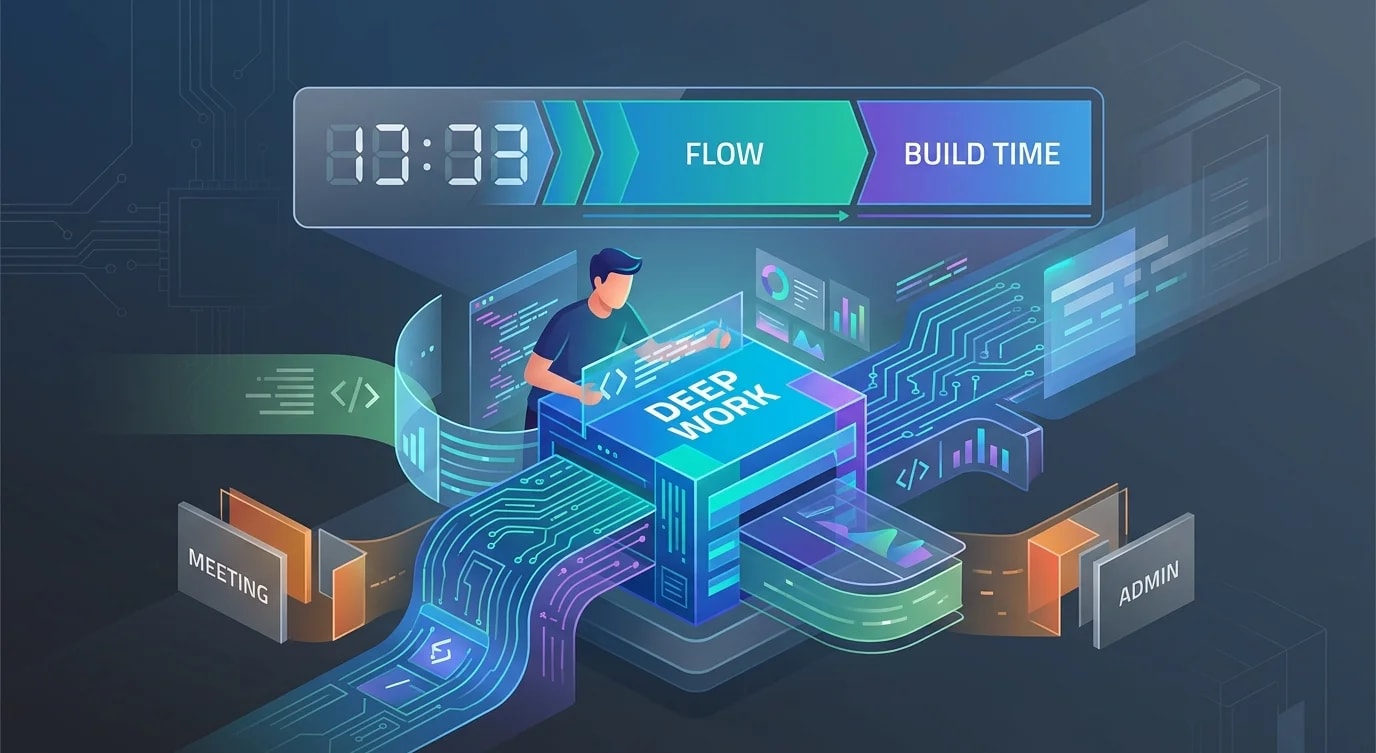
Deep Work: Structuring Your Day for Maximum Focus
Apply deep work to software development with concrete scheduling, environment design, interruption management and energy-aware task allocation.
Software development is deep work. Writing a complex algorithm, debugging a race condition, or designing a system architecture requires loading an intricate mental model into working memory and holding it there while you reason about interactions. Context switching—a Slack message, a meeting, a notification—flushes that model. Rebuilding it takes 15-25 minutes, not seconds.
Most developers get fewer than two uninterrupted hours per day. The rest is spent in meetings, responding to messages, and recovering from interruptions. Doubling those deep work hours doesn't require working more—it requires structuring your day so that focus periods are protected and shallow work is batched.
The Context-Switching Tax
Every interruption carries a hidden cost that goes beyond the interruption itself.
## The real cost of a 2-minute Slack reply

Timeline of a "quick" interruption:

10:00 — Deep in debugging a race condition
         Mental model loaded: 3 services,
         2 queues, timing-dependent state
10:05 — Slack notification: "Hey, quick question
         about the API response format"
10:06 — Read message, formulate reply
10:08 — Reply sent. Back to code.
10:08 — Wait, where was I?
10:10 — Re-reading the code I was looking at
10:15 — Partially reconstructing the mental model
10:22 — Back to the same depth I was at before

Total cost: 22 minutes for a 2-minute reply

Over a day with 8 interruptions:
8 × 22 minutes = 176 minutes = ~3 hours lost
The problem isn't that people ask questions. The problem is that questions arrive asynchronously and interrupt deep work. Batching communication protects focus without reducing responsiveness.
Time Blocking: Protecting Deep Work Hours
Block specific hours for deep work and defend them. This isn't about being unavailable—it's about being available at predictable times.
## Example daily schedule (deep work focused)

┌─────────────────────────────────────────────┐
│ 08:00-08:30  Morning routine                │
│   - Review plan for the day (5 min)         │
│   - Check only urgent messages (10 min)     │
│   - Set intention for deep work block       │
│                                             │
│ 08:30-11:30  DEEP WORK BLOCK 1 ████████    │
│   - Notifications OFF                       │
│   - Slack status: "Focused — back at 11:30" │
│   - Phone face-down                         │
│   - One task, one context                   │
│                                             │
│ 11:30-12:30  Shallow work batch             │
│   - Reply to all messages                   │
│   - Review PRs (time-boxed: 30 min)         │
│   - Quick decisions and approvals           │
│                                             │
│ 12:30-13:30  Lunch (actual break)           │
│                                             │
│ 13:30-15:30  DEEP WORK BLOCK 2 ████████    │
│   - Same focus rules as morning block       │
│   - Often best for creative/design work     │
│                                             │
│ 15:30-16:30  Meetings (batched)             │
│   - Stand-up, 1:1s, planning               │
│   - All meetings in this window if possible │
│                                             │
│ 16:30-17:00  End-of-day routine             │
│   - Process remaining messages              │
│   - Plan tomorrow's deep work task          │
│   - Write down where you left off           │
└─────────────────────────────────────────────┘

Deep work hours: 5.5 hours
Shallow work: 2.5 hours
That's a 2.2x ratio — most developers have it inverted
Energy-Aware Task Allocation
Not all hours are equal. Most people have peak cognitive energy in the morning. Matching task difficulty to energy level maximizes output.
## Task-energy matching

### Peak energy (morning, first deep work block)
Best for:
- Complex debugging
- Architecture design
- Algorithm implementation
- Writing new systems from scratch
- Difficult code reviews

### Moderate energy (afternoon, second deep work block)
Best for:
- Feature implementation with clear specs
- Refactoring and code cleanup
- Writing tests
- Documentation

### Low energy (end of day, between blocks)
Best for:
- Code reviews (straightforward ones)
- Slack responses and email
- Meeting attendance
- Administrative tasks
- Planning tomorrow

## Anti-pattern: scheduling your hardest problem for
## 3pm after back-to-back meetings
Environment Design
Your physical and digital environment either supports focus or sabotages it. Design it intentionally.
## Digital environment

### Notification audit
Go through every app on your phone and computer.
For each notification channel, ask:
"If I saw this 2 hours later, would anything bad happen?"

If no → turn it off.

### Communication batch schedule
- Slack: Check at 8:00, 11:30, 15:30
  (3x daily, not 30x daily)
- Email: Check at 11:30, 16:00
  (2x daily)
- Urgent: Phone call or walk over — always available
  (true urgencies don't come via Slack)

### Focus mode setup
1. Close all tabs except: editor, terminal, docs
2. Slack → set status, mute channels
3. Phone → Do Not Disturb
4. Music → Consistent background (brown noise, lo-fi)
5. Timer → Start 90-minute block// A developer's actual focus tracking
// (pseudocode for the concept)
interface FocusBlock {
start: Date;
end: Date;
task: string;
interruptions: number;
quality: "deep" | "medium" | "shallow";
}
function weeklyFocusReport(
blocks: FocusBlock[]
): {
totalDeepHours: number;
avgInterruptionsPerBlock: number;
bestTimeSlot: string;
worstTimeSlot: string;
} {
const deepBlocks = blocks.filter(
(b) => b.quality === "deep"
);
const totalDeepMs = deepBlocks.reduce(
(sum, b) =>
sum + (b.end.getTime() - b.start.getTime()),
0
);
const avgInterruptions =
blocks.reduce(
(sum, b) => sum + b.interruptions,
0
) / blocks.length;
// Find which time slots produce the most deep work
const slotMap = new Map<string, number>();
for (const block of deepBlocks) {
const hour = block.start.getHours();
const slot = `${hour}:00-${hour + 1}:00`;
const duration =
block.end.getTime() - block.start.getTime();
slotMap.set(
slot,
(slotMap.get(slot) ?? 0) + duration
);
}
const sorted = [...slotMap.entries()].sort(
(a, b) => b[1] - a[1]
);
return {
totalDeepHours: totalDeepMs / 3_600_000,
avgInterruptionsPerBlock:
Math.round(avgInterruptions * 10) / 10,
bestTimeSlot: sorted[0]?.[0] ?? "unknown",
worstTimeSlot:
sorted[sorted.length - 1]?.[0] ?? "unknown",
};
}Protecting Team Deep Work
Individual focus strategies work, but they're fragile if the team culture doesn't support them. As a team, establish norms that protect everyone's focus.
## Team agreements for deep work

### No-meeting mornings
- No meetings before 12:00 on Tue/Thu
- Everyone knows they have guaranteed focus blocks
- Stand-ups moved to 12:00

### Async-first communication
- Default: async (Slack message, document)
- Escalation: mention with @
- Urgent: phone call
- Rule: if it can wait 2 hours, it's async

### PR review SLA
- Reviews completed within 4 business hours
- But not immediately — scheduled in shallow work time
- Emergency reviews: use a specific channel

### Meeting hygiene
- Every meeting has an agenda and a decision to make
- Default length: 25 minutes (not 30)
- If it's informational only: send a document
- Decline meetings without agendas

### Focus status norms
- Red status = deep work, don't interrupt
- Green status = available for questions
- No judgment for being red most of the morning
Key Takeaways
Context switching costs 15-25 minutes per interruption to rebuild your mental model, meaning eight "quick" interruptions per day consume roughly three hours of productive time—protecting deep work hours yields more output than adding work hours. Time blocking with two 2-3 hour deep work periods per day and batching shallow work (messages, reviews, meetings) into specific windows gives most developers 2-3x more focused hours than the default reactive workday. Match task difficulty to energy levels: complex debugging and architecture design belong in peak-energy morning blocks, while code reviews and messages belong in lower-energy afternoon windows. Team-level agreements like no-meeting mornings, async-first communication norms, and focus status conventions multiply the effect because individual deep work strategies collapse when the culture expects instant responses.