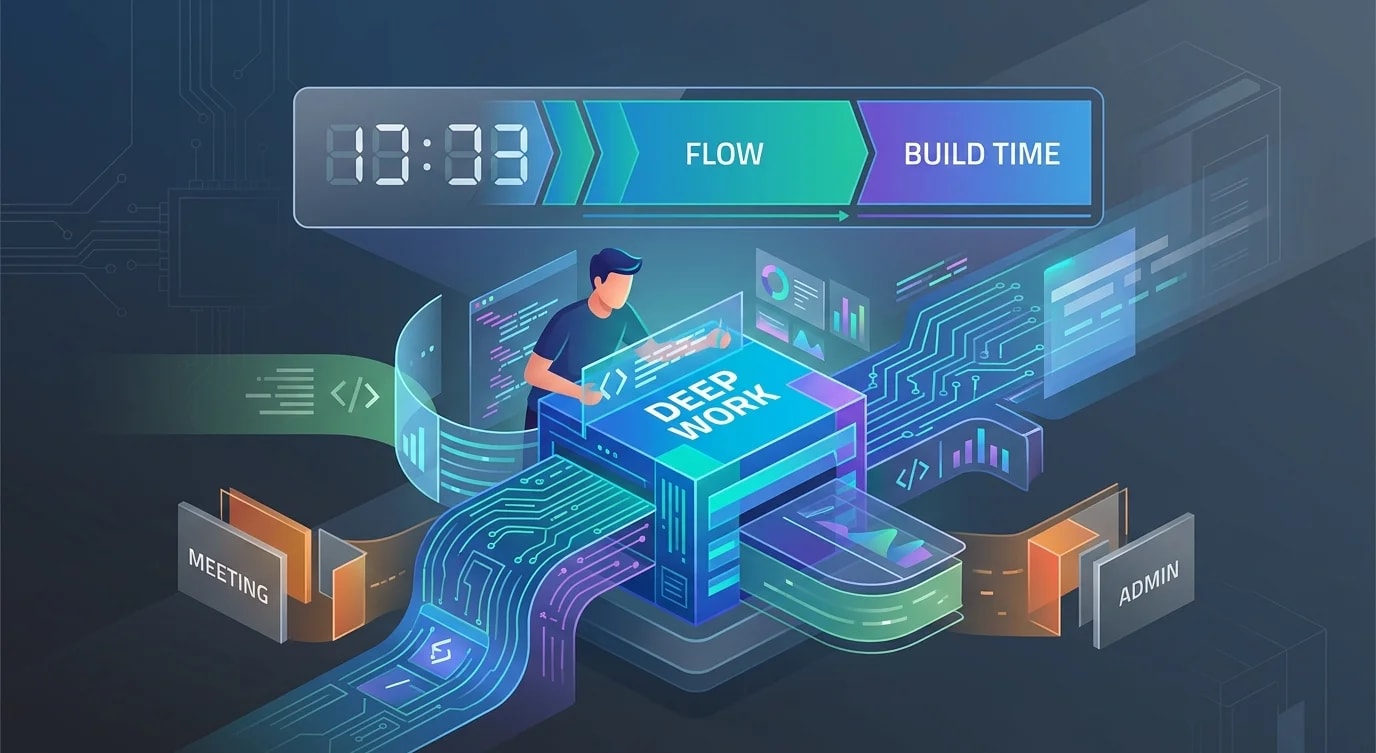
Deep Work: Den Tag für maximale Fokussierung strukturieren
Wende Deep-Work-Prinzipien auf die Entwicklung an: Planung, Umgebungsgestaltung, Unterbrechungsmanagement und energiebewusste Aufgabenverteilung.
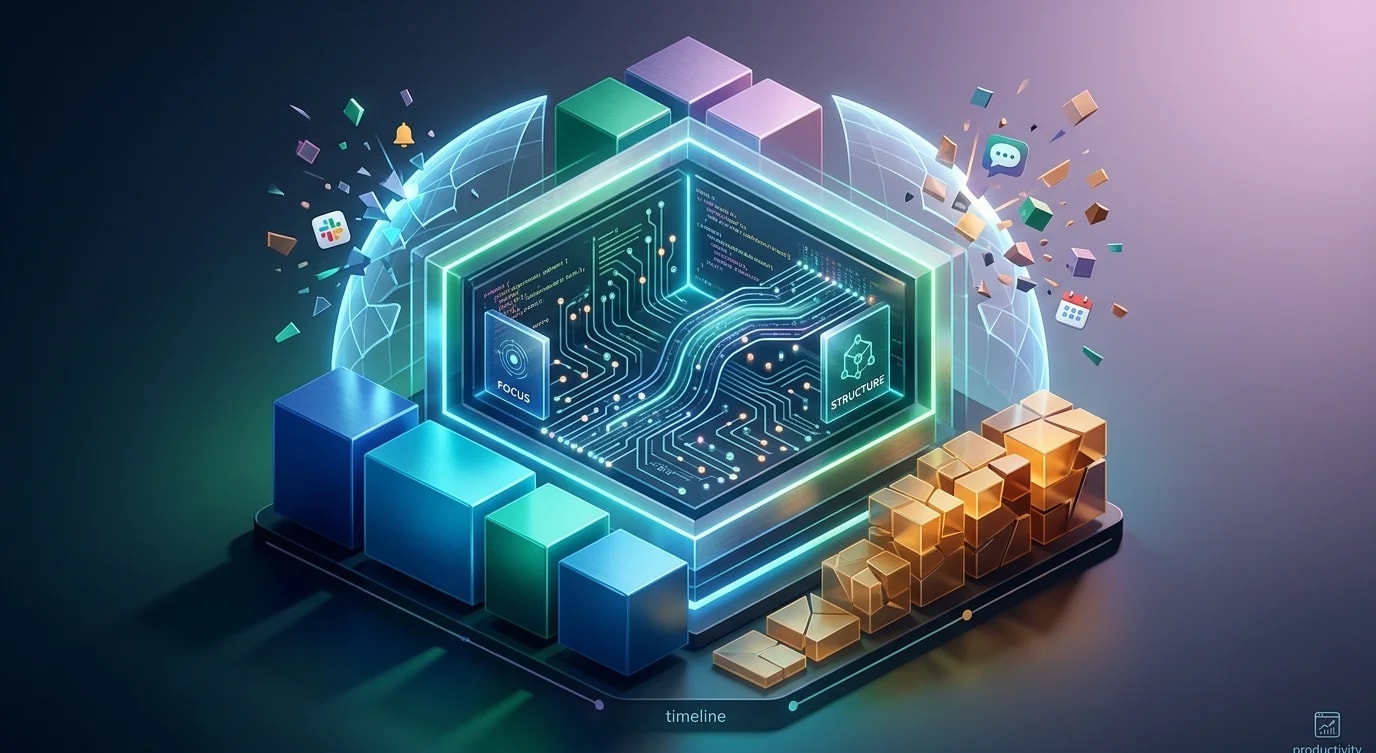
Softwareentwicklung ist Deep Work. Einen komplexen Algorithmus zu schreiben, einen Race Condition zu debuggen oder eine Systemarchitektur zu entwerfen erfordert, ein kompliziertes mentales Modell ins Arbeitsgedächtnis zu laden und dort zu behalten, während du über Wechselwirkungen nachdenkst. Ein Kontextwechsel—eine Slack-Nachricht, ein Meeting, eine Benachrichtigung—spült es heraus. Es wiederaufzubauen dauert 15-25 Minuten, nicht Sekunden.
Die meisten Entwickler haben weniger als zwei ununterbrochene Stunden pro Tag. Der Rest geht in Meetings, Nachrichtenbeantwortung und Erholung von Unterbrechungen. Diese Deep-Work-Stunden zu verdoppeln erfordert nicht mehr Arbeit—sondern einen Tagesablauf, in dem Fokuszeiten geschützt und flache Arbeit gebündelt werden.
Die Steuer des Kontextwechsels
Jede Unterbrechung hat verborgene Kosten, die über die Unterbrechung selbst hinausgehen.
## The real cost of a 2-minute Slack reply

Timeline of a "quick" interruption:

10:00 — Deep in debugging a race condition
         Mental model loaded: 3 services,
         2 queues, timing-dependent state
10:05 — Slack notification: "Hey, quick question
         about the API response format"
10:06 — Read message, formulate reply
10:08 — Reply sent. Back to code.
10:08 — Wait, where was I?
10:10 — Re-reading the code I was looking at
10:15 — Partially reconstructing the mental model
10:22 — Back to the same depth I was at before

Total cost: 22 minutes for a 2-minute reply

Over a day with 8 interruptions:
8 × 22 minutes = 176 minutes = ~3 hours lost
Das Problem ist nicht, dass Leute fragen. Das Problem ist, dass Fragen asynchron ankommen und Deep Work unterbrechen. Kommunikation zu bündeln schützt den Fokus, ohne die Erreichbarkeit zu verringern.
Zeitblockierung: Deep-Work-Stunden schützen
Blocke feste Stunden für Deep Work ein und verteidige sie. Es geht nicht darum, nicht erreichbar zu sein—sondern zu vorhersehbaren Zeiten erreichbar zu sein.
## Example daily schedule (deep work focused)

┌─────────────────────────────────────────────┐
│ 08:00-08:30  Morning routine                │
│   - Review plan for the day (5 min)         │
│   - Check only urgent messages (10 min)     │
│   - Set intention for deep work block       │
│                                             │
│ 08:30-11:30  DEEP WORK BLOCK 1 ████████    │
│   - Notifications OFF                       │
│   - Slack status: "Focused — back at 11:30" │
│   - Phone face-down                         │
│   - One task, one context                   │
│                                             │
│ 11:30-12:30  Shallow work batch             │
│   - Reply to all messages                   │
│   - Review PRs (time-boxed: 30 min)         │
│   - Quick decisions and approvals           │
│                                             │
│ 12:30-13:30  Lunch (actual break)           │
│                                             │
│ 13:30-15:30  DEEP WORK BLOCK 2 ████████    │
│   - Same focus rules as morning block       │
│   - Often best for creative/design work     │
│                                             │
│ 15:30-16:30  Meetings (batched)             │
│   - Stand-up, 1:1s, planning               │
│   - All meetings in this window if possible │
│                                             │
│ 16:30-17:00  End-of-day routine             │
│   - Process remaining messages              │
│   - Plan tomorrow's deep work task          │
│   - Write down where you left off           │
└─────────────────────────────────────────────┘

Deep work hours: 5.5 hours
Shallow work: 2.5 hours
That's a 2.2x ratio — most developers have it inverted
Energiebewusste Aufgabenverteilung
Nicht alle Stunden sind gleich. Die meisten Menschen haben am Morgen ihre kognitive Spitzenleistung. Schwierigkeit und Energielevel zusammenzubringen maximiert den Output.
## Task-energy matching

### Peak energy (morning, first deep work block)
Best for:
- Complex debugging
- Architecture design
- Algorithm implementation
- Writing new systems from scratch
- Difficult code reviews

### Moderate energy (afternoon, second deep work block)
Best for:
- Feature implementation with clear specs
- Refactoring and code cleanup
- Writing tests
- Documentation

### Low energy (end of day, between blocks)
Best for:
- Code reviews (straightforward ones)
- Slack responses and email
- Meeting attendance
- Administrative tasks
- Planning tomorrow

## Anti-pattern: scheduling your hardest problem for
## 3pm after back-to-back meetings
Umgebungsgestaltung
Deine physische und digitale Umgebung unterstützt den Fokus oder sabotiert ihn. Gestalte sie bewusst.
## Digital environment

### Notification audit
Go through every app on your phone and computer.
For each notification channel, ask:
"If I saw this 2 hours later, would anything bad happen?"

If no → turn it off.

### Communication batch schedule
- Slack: Check at 8:00, 11:30, 15:30
  (3x daily, not 30x daily)
- Email: Check at 11:30, 16:00
  (2x daily)
- Urgent: Phone call or walk over — always available
  (true urgencies don't come via Slack)

### Focus mode setup
1. Close all tabs except: editor, terminal, docs
2. Slack → set status, mute channels
3. Phone → Do Not Disturb
4. Music → Consistent background (brown noise, lo-fi)
5. Timer → Start 90-minute block// A developer's actual focus tracking
// (pseudocode for the concept)
interface FocusBlock {
start: Date;
end: Date;
task: string;
interruptions: number;
quality: "deep" | "medium" | "shallow";
}
function weeklyFocusReport(
blocks: FocusBlock[]
): {
totalDeepHours: number;
avgInterruptionsPerBlock: number;
bestTimeSlot: string;
worstTimeSlot: string;
} {
const deepBlocks = blocks.filter(
(b) => b.quality === "deep"
);
const totalDeepMs = deepBlocks.reduce(
(sum, b) =>
sum + (b.end.getTime() - b.start.getTime()),
0
);
const avgInterruptions =
blocks.reduce(
(sum, b) => sum + b.interruptions,
0
) / blocks.length;
// Find which time slots produce the most deep work
const slotMap = new Map<string, number>();
for (const block of deepBlocks) {
const hour = block.start.getHours();
const slot = `${hour}:00-${hour + 1}:00`;
const duration =
block.end.getTime() - block.start.getTime();
slotMap.set(
slot,
(slotMap.get(slot) ?? 0) + duration
);
}
const sorted = [...slotMap.entries()].sort(
(a, b) => b[1] - a[1]
);
return {
totalDeepHours: totalDeepMs / 3_600_000,
avgInterruptionsPerBlock:
Math.round(avgInterruptions * 10) / 10,
bestTimeSlot: sorted[0]?.[0] ?? "unknown",
worstTimeSlot:
sorted[sorted.length - 1]?.[0] ?? "unknown",
};
}Team-Deep-Work schützen
Individuelle Fokusstrategien funktionieren, aber sie sind fragil, wenn die Teamkultur sie nicht stützt. Legt als Team Normen fest, die den Fokus aller schützen.
## Team agreements for deep work

### No-meeting mornings
- No meetings before 12:00 on Tue/Thu
- Everyone knows they have guaranteed focus blocks
- Stand-ups moved to 12:00

### Async-first communication
- Default: async (Slack message, document)
- Escalation: mention with @
- Urgent: phone call
- Rule: if it can wait 2 hours, it's async

### PR review SLA
- Reviews completed within 4 business hours
- But not immediately — scheduled in shallow work time
- Emergency reviews: use a specific channel

### Meeting hygiene
- Every meeting has an agenda and a decision to make
- Default length: 25 minutes (not 30)
- If it's informational only: send a document
- Decline meetings without agendas

### Focus status norms
- Red status = deep work, don't interrupt
- Green status = available for questions
- No judgment for being red most of the morning
Wichtigste Erkenntnisse
Ein Kontextwechsel kostet 15-25 Minuten pro Unterbrechung, um das mentale Modell wiederaufzubauen—acht "schnelle" Unterbrechungen pro Tag verbrauchen also rund drei Stunden produktiver Zeit. Deep-Work-Stunden zu schützen bringt mehr Output als zusätzliche Arbeitsstunden. Zeitblockierung mit zwei 2- bis 3-stündigen Deep-Work-Perioden pro Tag und Bündelung flacher Arbeit (Nachrichten, Reviews, Meetings) in feste Fenster gibt den meisten Entwicklern 2-3x mehr fokussierte Stunden als der standardmäßig reaktive Arbeitstag. Passe die Aufgabenschwierigkeit dem Energielevel an: komplexes Debugging und Architekturdesign gehören in morgendliche Hochleistungsblöcke, Code-Reviews und Nachrichten in nachmittägige Tiefenergie-Fenster. Vereinbarungen auf Teamebene wie meetingfreie Morgen, Async-first-Kommunikationsnormen und Fokus-Status-Konventionen vervielfachen den Effekt, weil individuelle Deep-Work-Strategien kollabieren, wenn die Kultur sofortige Antworten erwartet.