Deep Work for Developers: Protecting Focus
Practical strategies to reclaim deep focus time, structure the workday around cognitive demand and build sustainable productivity habits.

The Cost of Context Switching in Software Development
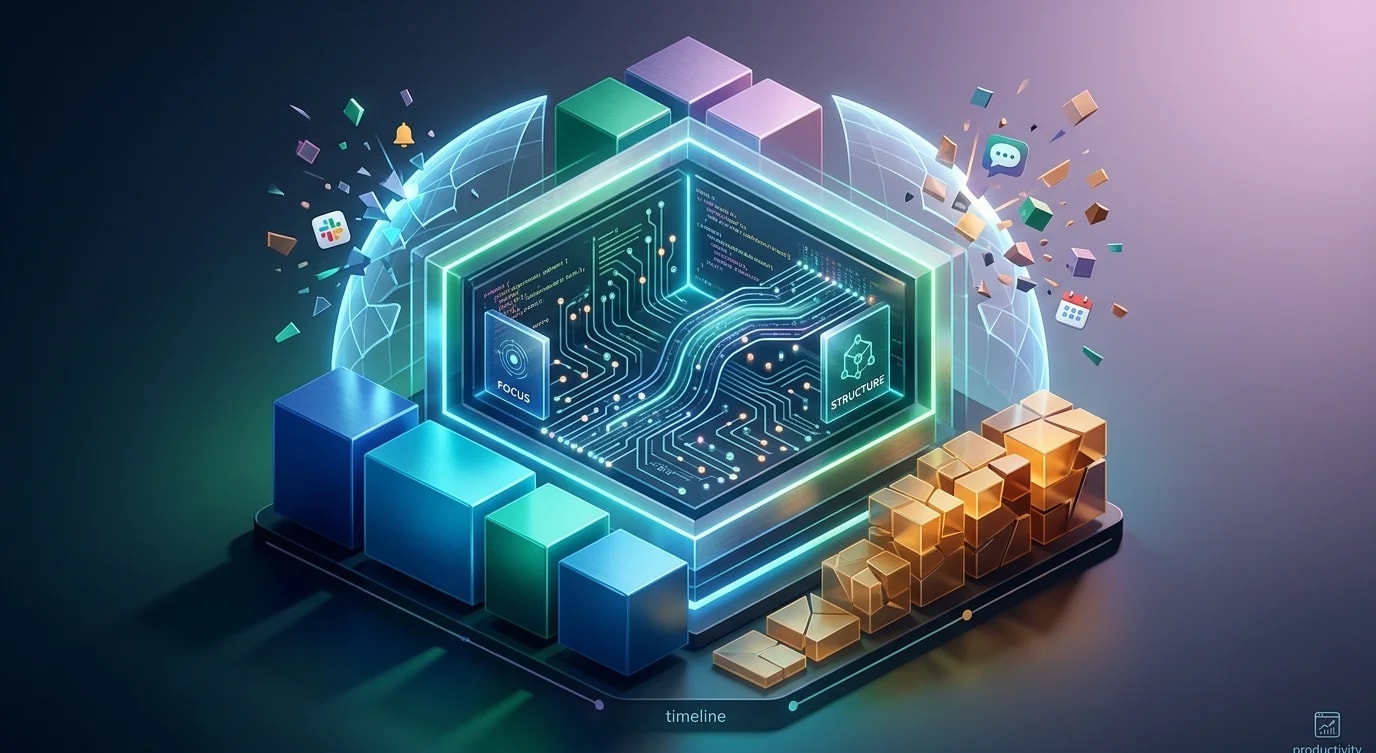
A Slack message takes three seconds to read. Recovering the mental context you lost takes twenty-three minutes. That number, from a University of California study, should terrify every developer who works with notifications enabled.
Programming is fundamentally a deep-thinking activity. You hold complex state in your head—data flows, type hierarchies, edge cases, the interaction between the function you are writing and the six functions that call it. An interruption vaporizes that mental model. You do not resume where you left off; you rebuild from scratch.
Most developers get two to three hours of genuinely uninterrupted time per day. The rest is fragmented across Slack threads, standup meetings, code review pings, and the ambient noise of organizational communication. This guide covers concrete strategies to protect and extend those deep work windows.
Structuring Your Day Around Cognitive Load
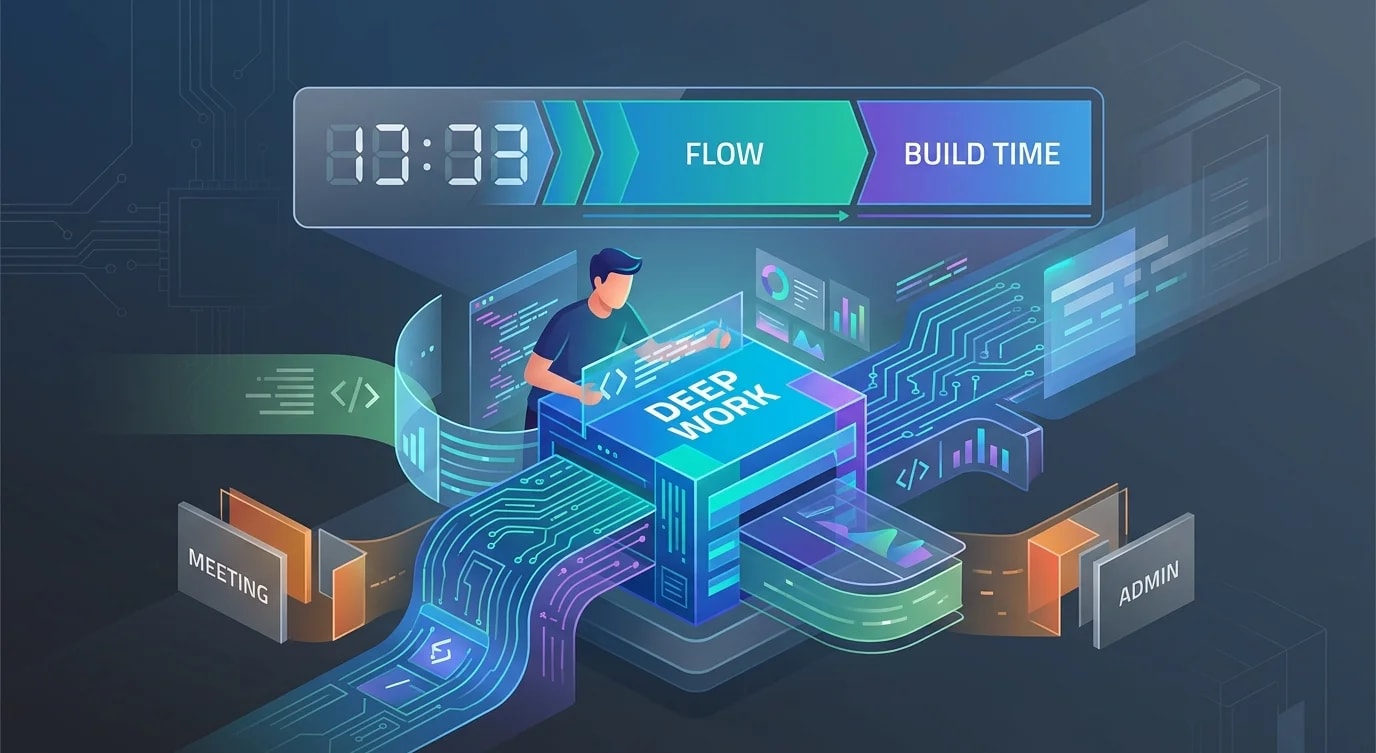
Not all programming tasks require the same cognitive effort. Architecting a new system demands deep focus. Reviewing a small pull request does not. The mistake is treating all work as interchangeable and letting meetings fragment your highest-value hours.
// A time-blocking system for developer workdays
interface TimeBlock {
  start: string;
  end: string;
  type: "deep" | "shallow" | "buffer";
  description: string;
  interruptible: boolean;
}

const idealDeveloperDay: TimeBlock[] = [
  {
    start: "08:00",
    end: "08:30",
    type: "shallow",
    description: "Triage: email, Slack, PR notifications",
    interruptible: true,
  },
  {
    start: "08:30",
    end: "12:00",
    type: "deep",
    description: "Primary deep work: architecture, complex features, debugging",
    interruptible: false,
  },
  {
    start: "12:00",
    end: "13:00",
    type: "buffer",
    description: "Lunch and informal conversations",
    interruptible: true,
  },
  {
    start: "13:00",
    end: "14:30",
    type: "shallow",
    description: "Meetings, code reviews, pair programming",
    interruptible: true,
  },
  {
    start: "14:30",
    end: "16:30",
    type: "deep",
    description: "Secondary deep work: implementation, testing, documentation",
    interruptible: false,
  },
  {
    start: "16:30",
    end: "17:00",
    type: "shallow",
    description: "Wrap-up: update tickets, plan tomorrow, async replies",
    interruptible: true,
  },
];
The key insight is batching shallow work. Instead of checking Slack every ten minutes, designate specific windows for communication. Most messages that feel urgent are not. A 30-minute response delay rarely causes problems; a 30-minute focus interruption always does.
Building a Focus Environment
Environment shapes behavior. If your notification settings, desktop layout, and communication tools default to maximum interruption, willpower alone will not protect deep work. You need systems.
// ❌ Bad: Default notification settings that interrupt constantly
const defaultSetup = {
  slack: {
    notifications: "all_messages",
    sounds: true,
    desktopAlerts: true,
    mobilePush: true,
  },
  email: {
    checkInterval: "instant",
    desktopNotifications: true,
  },
  calendar: {
    defaultMeetingLength: 60,
    allowBackToBack: true,
  },
};// ✅ Good: Intentional notification configuration for deep work
const focusOptimizedSetup = {
slack: {
notifications: "direct_messages_only",
sounds: false,
desktopAlerts: false,
mobilePush: false,
statusMessage: "Deep work until 12:00. Will respond after.",
scheduleOverride: {
dndStart: "08:30",
dndEnd: "12:00",
},
},
email: {
checkInterval: "manual",
desktopNotifications: false,
batchProcessTimes: ["08:00", "13:00", "16:30"],
},
calendar: {
defaultMeetingLength: 25,
allowBackToBack: false,
bufferBetweenMeetings: 10,
focusTimeBlocks: {
recurring: true,
days: ["monday", "tuesday", "wednesday", "thursday", "friday"],
timeSlot: { start: "08:30", end: "12:00" },
visibility: "busy",
},
},
};The 25-minute default meeting length is deliberate. Parkinson's law applies to meetings—they expand to fill available time. Most discussions that "need an hour" can conclude in 25 minutes with a clear agenda.
The Session Log: Maintaining Context Across Interruptions
Interruptions will happen despite your best defenses. The question is how quickly you can rebuild context afterward. A session log—a lightweight running document of what you are doing and thinking—dramatically reduces recovery time.
## Session Log: 2024-09-20

### Current Task: Refactor payment processing pipeline

**Where I left off:**
- Extracted `PaymentValidator` class from `processPayment()`
- Next: Move currency conversion logic into `CurrencyService`
- The edge case with JPY (zero-decimal currency) needs special handling
- Test file: `payment.test.ts` lines 145-200 cover this flow

**Mental context:**
- `processPayment()` currently does: validate → convert → charge → log
- After refactor: controller orchestrates 4 separate services
- The charging step must be idempotent (see idempotency key in request)
- Redis lock prevents duplicate charges during network retries

**Open questions:**
- Should CurrencyService cache exchange rates? (ask Sarah about API limits)
- Error handling: should validation errors prevent the charge or just log?
This takes thirty seconds to write before stepping away. It saves twenty minutes when you return. The "mental context" section is the most valuable part—it captures the invisible state that exists only in your working memory.
// Automating session capture with a simple CLI tool
import fs from "fs";
import path from "path";
import readline from "readline";

interface SessionEntry {
  timestamp: string;
  task: string;
  status: string;
  context: string;
  nextStep: string;
}

function createSessionLog(entries: SessionEntry[]): string {
  const date = new Date().toISOString().split("T")[0];
  let log = `# Session Log: ${date}\n\n`;

  for (const entry of entries) {
    log += `## ${entry.timestamp} — ${entry.task}\n`;
    log += `**Status:** ${entry.status}\n`;
    log += `**Context:** ${entry.context}\n`;
    log += `**Next step:** ${entry.nextStep}\n\n`;
  }

  return log;
}

function appendToLog(entry: SessionEntry): void {
  const date = new Date().toISOString().split("T")[0];
  const logPath = path.join(".sessions", `${date}.md`);
  const line = `\n## ${entry.timestamp} — ${entry.task}\n**Status:** ${entry.status}\n**Context:** ${entry.context}\n**Next step:** ${entry.nextStep}\n`;

  fs.mkdirSync(".sessions", { recursive: true });
  fs.appendFileSync(logPath, line, "utf-8");
}
Managing Energy, Not Just Time
Time management advice misses a critical variable: cognitive energy is not uniform throughout the day. Most developers experience peak analytical ability in the morning, a post-lunch dip, and a secondary peak in the mid-afternoon. Fighting this pattern wastes energy.
interface CognitiveTask {
  name: string;
  energyRequired: "high" | "medium" | "low";
  examples: string[];
}

const tasksByEnergy: CognitiveTask[] = [
  {
    name: "Architecture and design",
    energyRequired: "high",
    examples: [
      "System design",
      "Complex debugging",
      "Writing new algorithms",
      "Security reviews",
    ],
  },
  {
    name: "Implementation",
    energyRequired: "medium",
    examples: [
      "Feature implementation with clear spec",
      "Writing tests",
      "Code refactoring",
      "Documentation",
    ],
  },
  {
    name: "Administrative",
    energyRequired: "low",
    examples: [
      "Code reviews (small PRs)",
      "Updating tickets",
      "Responding to messages",
      "Dependency updates",
    ],
  },
];

function suggestTask(
  currentHour: number,
  tasks: CognitiveTask[]
): CognitiveTask | undefined {
  if (currentHour >= 8 && currentHour < 12) {
    return tasks.find((t) => t.energyRequired === "high");
  }
  if (currentHour >= 12 && currentHour < 14) {
    return tasks.find((t) => t.energyRequired === "low");
  }
  if (currentHour >= 14 && currentHour < 17) {
    return tasks.find((t) => t.energyRequired === "medium");
  }
  return undefined;
}
This is not rigid prescription—individual chronotypes vary. The principle is to observe your own energy patterns and align your highest-value work with your highest-energy windows. Most people intuitively know when they do their best work; the challenge is protecting that time from organizational demands.
Saying No Without Burning Bridges
The biggest threat to deep work is not Slack notifications—it is the inability to decline low-value commitments. Every "yes" to an unnecessary meeting is a "no" to focused coding time.
Effective pushback does not require conflict. It requires alternatives.
## Templates for Protecting Focus Time

### Declining a meeting:
"I won't be able to join this one — I'm in a deep work block.
Could you share notes afterward? If you need my input specifically,
I'm happy to review async or join a 15-minute follow-up."

### Deferring a Slack request:
"Saw this — will dig into it after 12:00 when I'm out of focus time.
If it's blocking you urgently, ping [backup person] who can help now."

### Proposing async alternatives:
"This might work better as a short RFC or Loom video.
That way everyone can review on their own schedule and
we skip the calendar Tetris."
The shift is from reactive availability to proactive communication. Post your focus schedule publicly. Set Slack status messages. Block calendar time visibly. When people know your patterns, they route around your deep work windows naturally.
Measuring What Matters
Productivity is not lines of code or tickets closed. It is the rate at which you solve meaningful problems. Track the inputs that lead to deep work, not vanity metrics.
interface WeeklyReview {
  deepWorkHours: number;
  interruptionCount: number;
  longestUnbrokenSession: number; // minutes
  tasksCompleted: number;
  significantDecisions: string[];
  energyPattern: string;
  adjustments: string[];
}

const weeklyReview: WeeklyReview = {
  deepWorkHours: 18,
  interruptionCount: 12,
  longestUnbrokenSession: 145, // 2h 25min
  tasksCompleted: 7,
  significantDecisions: [
    "Chose event-driven architecture over polling for notification service",
    "Decided to defer GraphQL migration to next quarter",
  ],
  energyPattern: "Strong mornings Mon-Wed, low energy Thu afternoon",
  adjustments: [
    "Move Thursday 1:1 to morning to protect afternoon",
    "Batch all code reviews to 13:00-14:00 window",
    "Add 10-min buffer after standup before deep work starts",
  ],
};
A weekly review cadence catches patterns that daily tracking misses. If your deep work hours decline three weeks in a row, something structural changed—a new recurring meeting, a shift in team responsibilities, or scope creep in your role. Catch it early and correct.
Key Takeaways
Deep work is not a luxury for developers—it is the core of the job. Every architectural decision, every complex debugging session, every algorithm you write requires sustained uninterrupted thought. Protecting that time is not selfish; it is professional.
The strategies are straightforward: batch shallow work, block deep focus time visibly, build session logs for context recovery, align cognitive demands with energy levels, and learn to decline low-value commitments gracefully. None of these require permission from your manager. They require intention from you.
The developers who ship the most impactful work are not the ones who respond fastest to Slack messages. They are the ones who disappear for three hours and emerge with solutions that move the project forward.