Navigating the Staff Engineer Path: Beyond Senior
What staff engineering actually involves, how technical leadership differs from management, and how senior engineers grow into organizational impact.
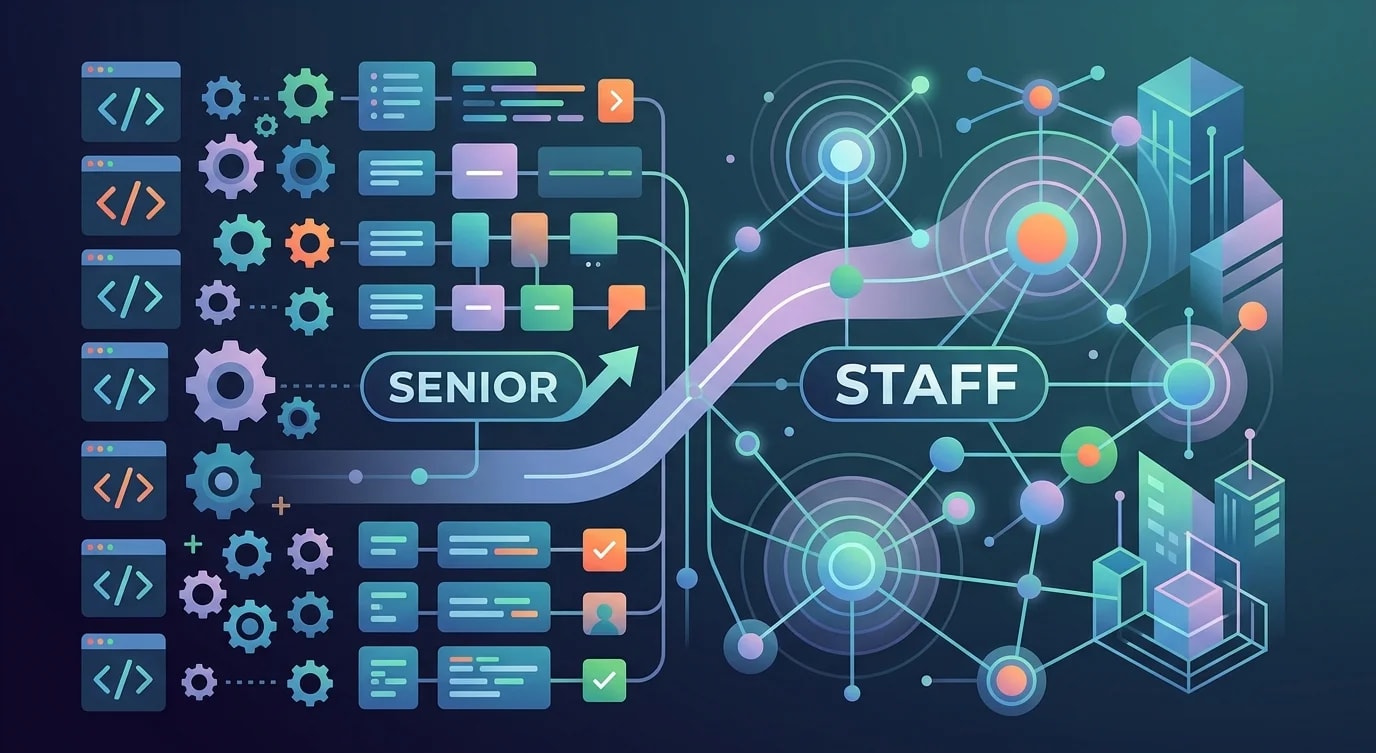
The jump from senior to staff engineer is the most confusing career transition in software. Senior engineers are evaluated on the code they write and the features they deliver. Staff engineers are evaluated on their organizational impact—often through work that's invisible in sprint boards and pull request counts.
Nobody tells you this explicitly, so engineers keep doing senior-level work faster and wonder why they aren't promoted.
What Staff Engineering Actually Is
Staff engineering isn't senior engineering with a bigger title. The scope of influence expands from team-level to organization-level, and the primary output shifts from code to decisions.
interface EngineeringLevel {
  title: string;
  scope: string;
  primaryOutput: string;
  evaluatedOn: string[];
  timeAllocation: {
    coding: number;
    design: number;
    communication: number;
    mentoring: number;
  };
}

const seniorEngineer: EngineeringLevel = {
  title: "Senior Engineer",
  scope: "Team — owns complex features end to end",
  primaryOutput: "Working software and technical quality",
  evaluatedOn: [
    "Feature delivery speed and quality",
    "Code review thoroughness",
    "Technical mentoring within the team",
    "Handling on-call and incidents",
  ],
  timeAllocation: {
    coding: 60,
    design: 15,
    communication: 15,
    mentoring: 10,
  },
};

const staffEngineer: EngineeringLevel = {
  title: "Staff Engineer",
  scope: "Organization — influences technical direction across teams",
  primaryOutput: "Technical strategy and leveling-up others",
  evaluatedOn: [
    "Cross-team technical alignment",
    "Identifying and solving org-level problems",
    "Raising the engineering bar across teams",
    "Unblocking others on ambiguous problems",
    "Technical vision and strategy documents",
  ],
  timeAllocation: {
    coding: 30,
    design: 30,
    communication: 25,
    mentoring: 15,
  },
};
The shift in time allocation is real. You code less—not because code doesn't matter, but because your leverage is highest when you're designing systems, aligning teams, and making decisions that affect multiple teams simultaneously.
The Four Staff Engineer Archetypes
Staff engineers don't all look the same. Will Larson identified four archetypes that describe how staff engineers create impact.
interface StaffArchetype {
  name: string;
  description: string;
  activities: string[];
  strengths: string[];
  risks: string[];
}

const archetypes: StaffArchetype[] = [
  {
    name: "Tech Lead",
    description: "Guides a team or group's technical direction",
    activities: [
      "Sets technical direction for complex projects",
      "Partners with product and engineering managers",
      "Ensures technical quality through design reviews",
      "Balances technical debt paydown with feature work",
    ],
    strengths: [
      "Deep empathy for team dynamics",
      "Strong project execution instincts",
    ],
    risks: [
      "Becoming a shadow manager",
      "Losing technical depth over time",
    ],
  },
  {
    name: "Architect",
    description: "Designs systems that span multiple teams",
    activities: [
      "Creates technical vision documents",
      "Reviews cross-team system designs",
      "Defines standards and patterns",
      "Evaluates build-vs-buy decisions",
    ],
    strengths: [
      "Broad technical knowledge across domains",
      "Long-term systems thinking",
    ],
    risks: [
      "Ivory tower disconnection from implementation",
      "Designing systems nobody can build",
    ],
  },
  {
    name: "Solver",
    description: "Parachutes into critical problems across the org",
    activities: [
      "Debugs the hardest production issues",
      "Tackles high-risk migrations",
      "Unblocks stalled technical projects",
      "Prototypes solutions for ambiguous problems",
    ],
    strengths: [
      "Deep technical expertise",
      "Comfort with ambiguity and pressure",
    ],
    risks: [
      "Becoming a bottleneck or hero",
      "Not building lasting organizational capability",
    ],
  },
  {
    name: "Right Hand",
    description: "Extends an executive's technical reach",
    activities: [
      "Represents engineering in cross-functional decisions",
      "Translates strategy into technical plans",
      "Monitors technical health across the org",
      "Facilitates alignment between engineering groups",
    ],
    strengths: [
      "Organizational awareness and influence",
      "Communication across technical and business contexts",
    ],
    risks: [
      "Losing individual contributor identity",
      "Role ambiguity with engineering managers",
    ],
  },
];
Most staff engineers blend two or three archetypes. Knowing which patterns fit your strengths helps you focus on the right activities.
Writing as a Staff Engineering Superpower
Staff engineers influence decisions they're not in the room for. Documents travel further than conversations.
// ❌ Common approach: verbal opinions in meetings
const ineffective = {
  approach: "Share technical opinion in team standup",
  reach: "5-8 people who happened to be in the meeting",
  persistence: "Forgotten by next week",
  influence: "Limited to local team decisions",
};

// ✅ Staff approach: written artifacts that scale
const effective = {
  approach: "Write technical strategy document",
  reach: "Entire engineering org, asynchronously",
  persistence: "Referenced for months, updated as context changes",
  influence: "Shapes decisions across multiple teams",
};interface TechnicalDocument {
type: string;
audience: string;
purpose: string;
structure: string[];
}
const staffDocuments: TechnicalDocument[] = [
{
type: "Technical Vision",
audience: "Engineering org + leadership",
purpose: "Describe desired future state and path to get there",
structure: [
"Current state: where are we and what problems exist",
"Desired state: what does success look like in 12-18 months",
"Gap analysis: what needs to change",
"Migration strategy: how we get from here to there",
"Success metrics: how we measure progress",
],
},
{
type: "Architecture Decision Record",
audience: "Engineering teams affected by the decision",
purpose: "Explain what was decided, why, and what alternatives were considered",
structure: [
"Context: the problem and constraints",
"Decision: what we chose",
"Alternatives considered: what we didn't choose and why",
"Consequences: trade-offs and what to watch for",
"Review date: when to reassess this decision",
],
},
{
type: "Investigation Report",
audience: "Product and engineering leadership",
purpose: "Summarize findings and recommend action on a technical problem",
structure: [
"Problem statement: what's happening and the business impact",
"Investigation findings: root causes with evidence",
"Options with trade-offs: at least 3 approaches",
"Recommendation: preferred option with reasoning",
"Resource estimate: effort and timeline for recommended option",
],
},
];Building Influence Without Authority
Staff engineers don't have direct reports. Their impact comes from influence, not authority. This requires fundamentally different skills than writing good code.
interface InfluenceStrategy {
  strategy: string;
  howItWorks: string;
  example: string;
}

const influenceStrategies: InfluenceStrategy[] = [
  {
    strategy: "Build trust through small wins",
    howItWorks:
      "Help teams solve their immediate problems before proposing big changes",
    example:
      "Fix a team's flaky test suite before proposing a testing framework migration",
  },
  {
    strategy: "Make the right thing easy",
    howItWorks:
      "Instead of mandating practices, provide tools that make good practices effortless",
    example:
      "Build a CI template with security scanning built in rather than writing a policy doc",
  },
  {
    strategy: "Ask questions instead of giving answers",
    howItWorks:
      "Guide teams to discover the right approach rather than dictating solutions",
    example:
      "'What happens if this service gets 10x traffic?' instead of 'You need to add caching'",
  },
  {
    strategy: "Show, don't tell",
    howItWorks:
      "Prototype solutions that demonstrate value rather than writing proposals",
    example:
      "Build a working proof-of-concept for the new logging pipeline in an afternoon",
  },
  {
    strategy: "Create alignment through shared context",
    howItWorks:
      "Ensure decision-makers have the same information you have",
    example:
      "Send a weekly technical digest summarizing cross-team dependencies and risks",
  },
];
Measuring Staff-Level Impact
The hardest part of staff engineering is demonstrating impact when your work doesn't show up in Jira tickets.
interface ImpactCategory {
  category: string;
  examples: string[];
  howToTrack: string;
}

const impactCategories: ImpactCategory[] = [
  {
    category: "Force multiplier",
    examples: [
      "Created shared library that saved 3 teams 2 weeks each",
      "Design review caught architecture flaw that would've caused a rewrite",
      "Mentored 2 engineers to senior level promotions",
    ],
    howToTrack: "Keep a running log of decisions influenced and time saved",
  },
  {
    category: "Risk reduction",
    examples: [
      "Identified and mitigated single points of failure before an outage",
      "Led migration off deprecated dependency before it became critical",
      "Established incident response process that cut MTTR by 40%",
    ],
    howToTrack: "Document what didn't happen because of your interventions",
  },
  {
    category: "Technical direction",
    examples: [
      "Authored API design standards adopted by all teams",
      "Led evaluation and selection of observability stack",
      "Created migration plan from monolith to services",
    ],
    howToTrack: "Link to documents, decisions, and adoption metrics",
  },
];
Key Takeaways
The staff engineer transition is about shifting from personal output to organizational impact. You code less—not because it doesn't matter, but because your highest leverage comes from designing systems, writing documents that travel further than conversations, and creating tools that make every team more effective. Find which archetype fits your strengths—tech lead, architect, solver, or right hand—and lean into the activities where you create the most value. Build influence through trust and demonstrated competence, not authority. Track your impact deliberately because force-multiplier work and risk-prevention work are invisible by default. The engineers who navigate this transition successfully are the ones who learn to measure their value not by what they built, but by what the entire organization built because of their contributions.