Der Weg zum Staff Engineer: mehr als nur Senior
Was die Rolle des Staff Engineers ausmacht, wie sich technische Führung von Management unterscheidet und wie man in diese Wirkung hineinwächst.
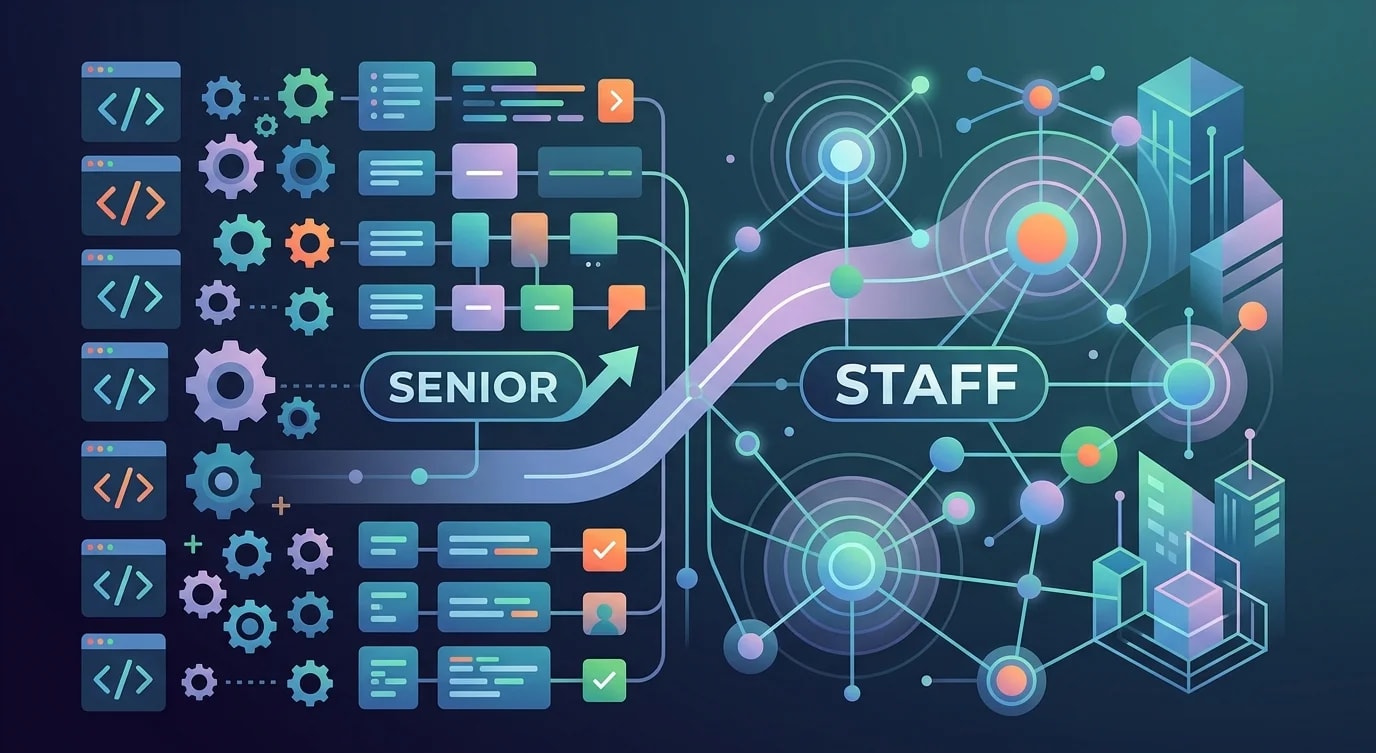
Der Sprung vom Senior zum Staff Engineer ist der verwirrendste Karriereschritt in der Softwarebranche. Senior Engineers werden an dem Code gemessen, den sie schreiben, und an den Features, die sie liefern. Staff Engineers dagegen werden an ihrer organisationsweiten Wirkung gemessen – oft durch Arbeit, die in Sprint-Boards und Pull-Request-Zahlen gar nicht sichtbar wird.
Das sagt dir niemand direkt, weshalb viele Engineers einfach immer schneller auf Senior-Niveau weiterarbeiten und sich fragen, warum sie nicht befördert werden.
Was die Arbeit als Staff Engineer wirklich ausmacht
Staff Engineering ist nicht einfach Senior Engineering mit einem größeren Titel. Der Einflussbereich wächst von der Team- auf die Organisationsebene, und das primäre Ergebnis der Arbeit verschiebt sich von Code hin zu Entscheidungen.
interface EngineeringLevel {
  title: string;
  scope: string;
  primaryOutput: string;
  evaluatedOn: string[];
  timeAllocation: {
    coding: number;
    design: number;
    communication: number;
    mentoring: number;
  };
}

const seniorEngineer: EngineeringLevel = {
  title: "Senior Engineer",
  scope: "Team — owns complex features end to end",
  primaryOutput: "Working software and technical quality",
  evaluatedOn: [
    "Feature delivery speed and quality",
    "Code review thoroughness",
    "Technical mentoring within the team",
    "Handling on-call and incidents",
  ],
  timeAllocation: {
    coding: 60,
    design: 15,
    communication: 15,
    mentoring: 10,
  },
};

const staffEngineer: EngineeringLevel = {
  title: "Staff Engineer",
  scope: "Organization — influences technical direction across teams",
  primaryOutput: "Technical strategy and leveling-up others",
  evaluatedOn: [
    "Cross-team technical alignment",
    "Identifying and solving org-level problems",
    "Raising the engineering bar across teams",
    "Unblocking others on ambiguous problems",
    "Technical vision and strategy documents",
  ],
  timeAllocation: {
    coding: 30,
    design: 30,
    communication: 25,
    mentoring: 15,
  },
};
Diese Verschiebung in der Zeitaufteilung ist real. Du programmierst weniger – nicht weil Code unwichtig wäre, sondern weil deine Hebelwirkung am größten ist, wenn du Systeme entwirfst, Teams aufeinander abstimmst und Entscheidungen triffst, die mehrere Teams gleichzeitig betreffen.
Die vier Archetypen des Staff Engineers
Nicht alle Staff Engineers sind gleich. Will Larson hat vier Archetypen identifiziert, die beschreiben, auf welche Weise Staff Engineers Wirkung erzielen.
interface StaffArchetype {
  name: string;
  description: string;
  activities: string[];
  strengths: string[];
  risks: string[];
}

const archetypes: StaffArchetype[] = [
  {
    name: "Tech Lead",
    description: "Guides a team or group's technical direction",
    activities: [
      "Sets technical direction for complex projects",
      "Partners with product and engineering managers",
      "Ensures technical quality through design reviews",
      "Balances technical debt paydown with feature work",
    ],
    strengths: [
      "Deep empathy for team dynamics",
      "Strong project execution instincts",
    ],
    risks: [
      "Becoming a shadow manager",
      "Losing technical depth over time",
    ],
  },
  {
    name: "Architect",
    description: "Designs systems that span multiple teams",
    activities: [
      "Creates technical vision documents",
      "Reviews cross-team system designs",
      "Defines standards and patterns",
      "Evaluates build-vs-buy decisions",
    ],
    strengths: [
      "Broad technical knowledge across domains",
      "Long-term systems thinking",
    ],
    risks: [
      "Ivory tower disconnection from implementation",
      "Designing systems nobody can build",
    ],
  },
  {
    name: "Solver",
    description: "Parachutes into critical problems across the org",
    activities: [
      "Debugs the hardest production issues",
      "Tackles high-risk migrations",
      "Unblocks stalled technical projects",
      "Prototypes solutions for ambiguous problems",
    ],
    strengths: [
      "Deep technical expertise",
      "Comfort with ambiguity and pressure",
    ],
    risks: [
      "Becoming a bottleneck or hero",
      "Not building lasting organizational capability",
    ],
  },
  {
    name: "Right Hand",
    description: "Extends an executive's technical reach",
    activities: [
      "Represents engineering in cross-functional decisions",
      "Translates strategy into technical plans",
      "Monitors technical health across the org",
      "Facilitates alignment between engineering groups",
    ],
    strengths: [
      "Organizational awareness and influence",
      "Communication across technical and business contexts",
    ],
    risks: [
      "Losing individual contributor identity",
      "Role ambiguity with engineering managers",
    ],
  },
];
Die meisten Staff Engineers vereinen zwei oder drei Archetypen in sich. Wenn du weißt, welche Muster zu deinen Stärken passen, hilft dir das, dich auf die richtigen Aktivitäten zu konzentrieren.
Schreiben als Superkraft des Staff Engineers
Staff Engineers beeinflussen Entscheidungen, die in Räumen fallen, in denen sie gar nicht anwesend sind. Dokumente reichen weiter als Gespräche.
// ❌ Common approach: verbal opinions in meetings
const ineffective = {
  approach: "Share technical opinion in team standup",
  reach: "5-8 people who happened to be in the meeting",
  persistence: "Forgotten by next week",
  influence: "Limited to local team decisions",
};

// ✅ Staff approach: written artifacts that scale
const effective = {
  approach: "Write technical strategy document",
  reach: "Entire engineering org, asynchronously",
  persistence: "Referenced for months, updated as context changes",
  influence: "Shapes decisions across multiple teams",
};interface TechnicalDocument {
type: string;
audience: string;
purpose: string;
structure: string[];
}
const staffDocuments: TechnicalDocument[] = [
{
type: "Technical Vision",
audience: "Engineering org + leadership",
purpose: "Describe desired future state and path to get there",
structure: [
"Current state: where are we and what problems exist",
"Desired state: what does success look like in 12-18 months",
"Gap analysis: what needs to change",
"Migration strategy: how we get from here to there",
"Success metrics: how we measure progress",
],
},
{
type: "Architecture Decision Record",
audience: "Engineering teams affected by the decision",
purpose: "Explain what was decided, why, and what alternatives were considered",
structure: [
"Context: the problem and constraints",
"Decision: what we chose",
"Alternatives considered: what we didn't choose and why",
"Consequences: trade-offs and what to watch for",
"Review date: when to reassess this decision",
],
},
{
type: "Investigation Report",
audience: "Product and engineering leadership",
purpose: "Summarize findings and recommend action on a technical problem",
structure: [
"Problem statement: what's happening and the business impact",
"Investigation findings: root causes with evidence",
"Options with trade-offs: at least 3 approaches",
"Recommendation: preferred option with reasoning",
"Resource estimate: effort and timeline for recommended option",
],
},
];Einfluss ohne Autorität aufbauen
Staff Engineers haben keine direkt unterstellten Mitarbeitenden. Ihre Wirkung entsteht durch Einfluss, nicht durch Autorität – und das erfordert grundlegend andere Fähigkeiten als das Schreiben von gutem Code.
interface InfluenceStrategy {
  strategy: string;
  howItWorks: string;
  example: string;
}

const influenceStrategies: InfluenceStrategy[] = [
  {
    strategy: "Build trust through small wins",
    howItWorks:
      "Help teams solve their immediate problems before proposing big changes",
    example:
      "Fix a team's flaky test suite before proposing a testing framework migration",
  },
  {
    strategy: "Make the right thing easy",
    howItWorks:
      "Instead of mandating practices, provide tools that make good practices effortless",
    example:
      "Build a CI template with security scanning built in rather than writing a policy doc",
  },
  {
    strategy: "Ask questions instead of giving answers",
    howItWorks:
      "Guide teams to discover the right approach rather than dictating solutions",
    example:
      "'What happens if this service gets 10x traffic?' instead of 'You need to add caching'",
  },
  {
    strategy: "Show, don't tell",
    howItWorks:
      "Prototype solutions that demonstrate value rather than writing proposals",
    example:
      "Build a working proof-of-concept for the new logging pipeline in an afternoon",
  },
  {
    strategy: "Create alignment through shared context",
    howItWorks:
      "Ensure decision-makers have the same information you have",
    example:
      "Send a weekly technical digest summarizing cross-team dependencies and risks",
  },
];
Wirkung auf Staff-Ebene messen
Der schwierigste Teil der Arbeit als Staff Engineer ist es, Wirkung nachzuweisen, wenn sie sich nicht in Jira-Tickets niederschlägt.
interface ImpactCategory {
  category: string;
  examples: string[];
  howToTrack: string;
}

const impactCategories: ImpactCategory[] = [
  {
    category: "Force multiplier",
    examples: [
      "Created shared library that saved 3 teams 2 weeks each",
      "Design review caught architecture flaw that would've caused a rewrite",
      "Mentored 2 engineers to senior level promotions",
    ],
    howToTrack: "Keep a running log of decisions influenced and time saved",
  },
  {
    category: "Risk reduction",
    examples: [
      "Identified and mitigated single points of failure before an outage",
      "Led migration off deprecated dependency before it became critical",
      "Established incident response process that cut MTTR by 40%",
    ],
    howToTrack: "Document what didn't happen because of your interventions",
  },
  {
    category: "Technical direction",
    examples: [
      "Authored API design standards adopted by all teams",
      "Led evaluation and selection of observability stack",
      "Created migration plan from monolith to services",
    ],
    howToTrack: "Link to documents, decisions, and adoption metrics",
  },
];
Die wichtigsten Erkenntnisse
Beim Übergang zum Staff Engineer geht es darum, von persönlicher Produktivität zu organisationsweiter Wirkung zu wechseln. Du programmierst weniger – nicht weil es unwichtig wäre, sondern weil deine größte Hebelwirkung darin liegt, Systeme zu entwerfen, Dokumente zu schreiben, die weiter reichen als Gespräche, und Werkzeuge zu schaffen, die jedes Team effektiver machen. Finde heraus, welcher Archetyp am besten zu deinen Stärken passt – Tech Lead, Architect, Solver oder Right Hand – und konzentriere dich auf die Aktivitäten, bei denen du den größten Wert schaffst. Baue Einfluss durch Vertrauen und nachgewiesene Kompetenz auf, nicht durch Autorität. Erfasse deine Wirkung bewusst, denn Arbeit, die als Kraftmultiplikator wirkt, und Arbeit, die Risiken verhindert, bleiben von Natur aus unsichtbar. Die Engineers, die diesen Übergang erfolgreich meistern, sind diejenigen, die lernen, ihren Wert nicht an dem zu messen, was sie selbst gebaut haben, sondern an dem, was die gesamte Organisation dank ihres Beitrags erreicht hat.