Incident Management: Von der Erkennung zum Post-Mortem
Ein systematischer Ansatz für Incident Management: Alert-Design, Schweregrade, On-Call-Workflows, Kommunikation und schuldfreie Post-Mortems.
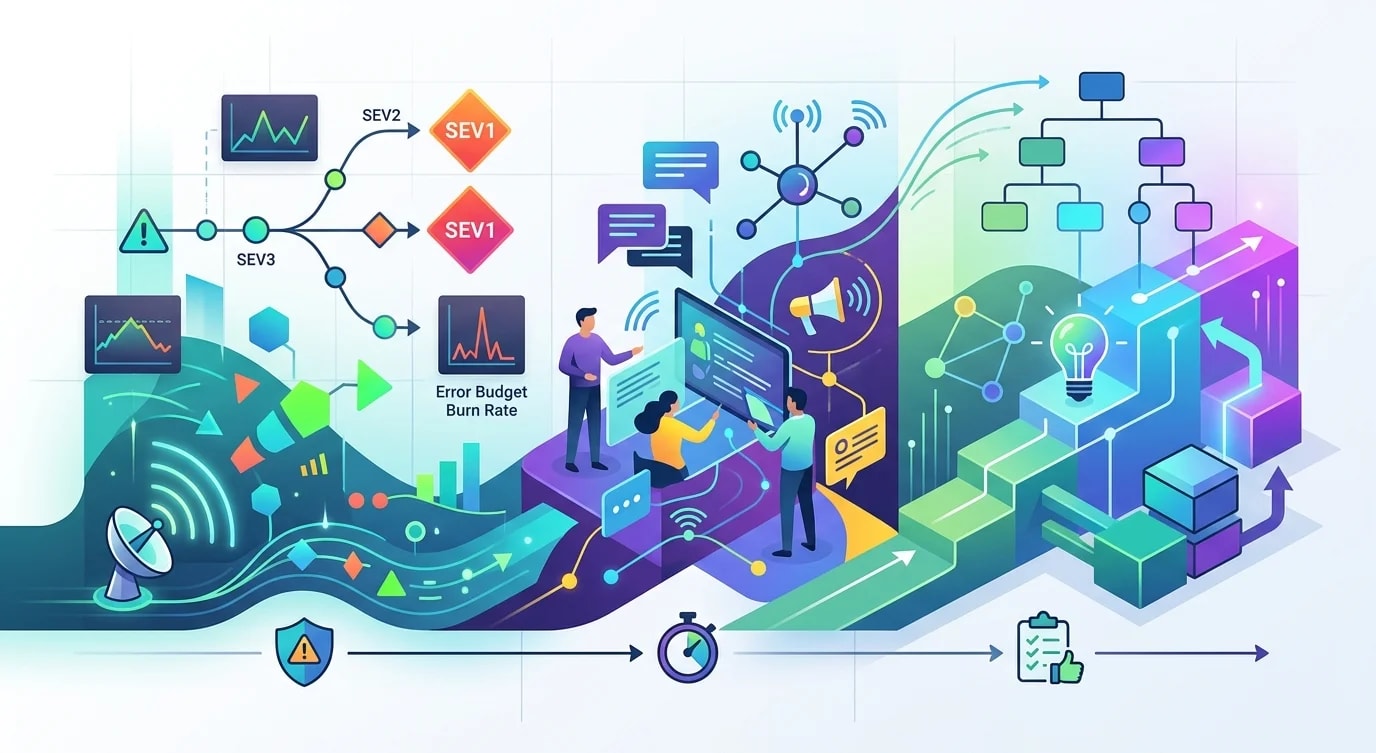
Vorfälle sind unvermeidlich—Chaos ist optional
Jedes System in Produktion wird irgendwann Vorfälle haben. Der Unterschied zwischen Teams, die gut damit umgehen, und solchen, die es nicht tun, liegt nicht am technischen Talent, sondern am Prozess. Ein klares Incident-Management-Framework verkürzt die mittlere Wiederherstellungszeit, verhindert organisationsweite Panik und macht aus jedem Ausfall eine Lerngelegenheit.
Dieser Leitfaden deckt den gesamten Lebenszyklus eines Vorfalls ab: Erkennung, Klassifizierung, Reaktion, Kommunikation, Behebung und das Post-Mortem, das ein erneutes Auftreten verhindert.
Alert-Design, das Rauschen reduziert
Der erste Schritt im Incident Management ist die Erkennung. Schlecht gestaltete Alerts führen zu Alert-Fatigue, wodurch das Team echte Probleme irgendwann ignoriert.
// ❌ Noisy alerting — triggers on transient spikes
interface BadAlert {
  name: string;
  condition: string;
  problem: string;
}

const noisyAlerts: BadAlert[] = [
  {
    name: "CPU > 80%",
    condition: "Any single data point above threshold",
    problem: "Triggers on 2-second spikes during deployments",
  },
  {
    name: "Any 5xx error",
    condition: "Single error occurrence",
    problem: "Triggers on retry-handled transient failures",
  },
];

// ✅ Meaningful alerting — symptom-based with burn rate
interface AlertRule {
  name: string;
  severity: "critical" | "warning" | "info";
  condition: {
    metric: string;
    operator: "gt" | "lt";
    threshold: number;
    window: string;
    evaluationPeriods: number;
  };
  notification: {
    channel: string;
    escalationAfter?: string;
  };
}

const meaningfulAlerts: AlertRule[] = [
  {
    name: "Error budget burn rate — critical",
    severity: "critical",
    condition: {
      metric: "sli:availability:error_budget_burn_rate",
      operator: "gt",
      threshold: 14.4,
      window: "5m",
      evaluationPeriods: 1,
    },
    notification: {
      channel: "pagerduty-critical",
      escalationAfter: "5m",
    },
  },
  {
    name: "Error budget burn rate — warning",
    severity: "warning",
    condition: {
      metric: "sli:availability:error_budget_burn_rate",
      operator: "gt",
      threshold: 1.0,
      window: "1h",
      evaluationPeriods: 3,
    },
    notification: {
      channel: "slack-oncall",
    },
  },
  {
    name: "P99 latency SLO breach",
    severity: "critical",
    condition: {
      metric: "http_request_duration_p99",
      operator: "gt",
      threshold: 2000,
      window: "10m",
      evaluationPeriods: 2,
    },
    notification: {
      channel: "pagerduty-critical",
      escalationAfter: "10m",
    },
  },
];
Alerts sollten auf Symptomen (der für Nutzer spürbaren Auswirkung) basieren, nicht auf Ursachen (etwa der CPU-Auslastung). Ein Burn-Rate-Alert zeigt an, dass das Error-Budget schneller aufgebraucht wird, als es nachhaltig wäre—was sich unmittelbar auf die Nutzererfahrung auswirkt.
Framework zur Schweregrad-Klassifizierung
Der Schweregrad bestimmt die Dringlichkeit der Reaktion und die Kommunikationsanforderungen. Ein klares Framework verhindert sowohl Unter- als auch Überreaktionen.
interface SeverityLevel {
  level: "SEV1" | "SEV2" | "SEV3" | "SEV4";
  description: string;
  criteria: string[];
  responseTime: string;
  communicationCadence: string;
  exampleScenarios: string[];
}

const severityFramework: SeverityLevel[] = [
  {
    level: "SEV1",
    description: "Critical — Complete service outage or data loss",
    criteria: [
      "Core functionality unavailable for all users",
      "Data corruption or loss occurring",
      "Security breach with active exploitation",
    ],
    responseTime: "Acknowledge within 5 minutes",
    communicationCadence: "Status update every 15 minutes",
    exampleScenarios: [
      "Payment processing completely down",
      "Database primary node unrecoverable",
      "Authentication service returning 500 for all requests",
    ],
  },
  {
    level: "SEV2",
    description: "Major — Significant degradation or partial outage",
    criteria: [
      "Core functionality degraded for subset of users",
      "Non-core functionality completely unavailable",
      "Performance degradation exceeding 3x normal latency",
    ],
    responseTime: "Acknowledge within 15 minutes",
    communicationCadence: "Status update every 30 minutes",
    exampleScenarios: [
      "Search returning stale results",
      "Image uploads failing for EU region",
      "API latency at 5s instead of normal 200ms",
    ],
  },
  {
    level: "SEV3",
    description: "Minor — Limited impact, workaround available",
    criteria: [
      "Non-critical feature degraded",
      "Issue affects small percentage of users",
      "Manual workaround available",
    ],
    responseTime: "Acknowledge within 1 hour",
    communicationCadence: "Status update every 2 hours",
    exampleScenarios: [
      "Email notifications delayed by 10 minutes",
      "Dashboard chart rendering incorrectly on mobile",
    ],
  },
  {
    level: "SEV4",
    description: "Informational — Cosmetic or minor issues",
    criteria: [
      "No user-facing impact",
      "Cosmetic issues",
      "Monitoring anomaly without impact",
    ],
    responseTime: "Next business day",
    communicationCadence: "Resolution summary only",
    exampleScenarios: [
      "Internal admin tool UI misalignment",
      "Log volume spike without errors",
    ],
  },
];
Workflow für die Vorfallreaktion
Sobald ein Vorfall erkannt und klassifiziert ist, folgt die Reaktion einem strukturierten Workflow mit klar definierten Rollen.
interface IncidentRole {
  role: string;
  responsibilities: string[];
  requiredSkills: string[];
}

const incidentRoles: IncidentRole[] = [
  {
    role: "Incident Commander (IC)",
    responsibilities: [
      "Coordinate response efforts",
      "Make decisions about severity and escalation",
      "Ensure communication cadence is maintained",
      "Decide when incident is resolved",
    ],
    requiredSkills: [
      "Calm under pressure",
      "Cross-team communication",
      "Decision-making with incomplete information",
    ],
  },
  {
    role: "Technical Lead",
    responsibilities: [
      "Investigate root cause",
      "Propose and implement mitigations",
      "Coordinate with other engineers on debugging",
    ],
    requiredSkills: [
      "Deep system knowledge",
      "Debugging under pressure",
      "Ability to explain technical details clearly",
    ],
  },
  {
    role: "Communications Lead",
    responsibilities: [
      "Draft and publish status page updates",
      "Coordinate with customer support",
      "Handle executive and stakeholder communications",
    ],
    requiredSkills: [
      "Clear writing under pressure",
      "Stakeholder management",
      "Empathy for user impact",
    ],
  },
];

interface IncidentTimeline {
  incidentId: string;
  severity: string;
  events: Array<{
    timestamp: Date;
    actor: string;
    action: string;
    details: string;
  }>;
}

function logTimelineEvent(
  timeline: IncidentTimeline,
  actor: string,
  action: string,
  details: string
): void {
  timeline.events.push({
    timestamp: new Date(),
    actor,
    action,
    details,
  });
}
Vorlagen für die Statuskommunikation
Eine klare, konsistente Kommunikation während eines Vorfalls verringert die Verunsicherung bei Nutzern, im Kundensupport und in der Führungsebene.
interface StatusUpdate {
  severity: string;
  status: "investigating" | "identified" | "monitoring" | "resolved";
  affectedServices: string[];
  userImpact: string;
  currentAction: string;
  nextUpdate: string;
}

function formatStatusUpdate(update: StatusUpdate): string {
  const timestamp = new Date().toISOString();

  return `
**Incident Update** — ${timestamp}
**Severity**: ${update.severity}
**Status**: ${update.status.toUpperCase()}
**Affected Services**: ${update.affectedServices.join(", ")}

**Impact**: ${update.userImpact}

**Current Action**: ${update.currentAction}

**Next Update**: ${update.nextUpdate}
  `.trim();
}

// Example usage
const update = formatStatusUpdate({
  severity: "SEV2",
  status: "identified",
  affectedServices: ["API Gateway", "User Authentication"],
  userImpact:
    "Approximately 15% of login attempts are failing with timeout errors. Users who are already authenticated are not affected.",
  currentAction:
    "We have identified elevated connection pool exhaustion on the auth database. We are scaling the connection pool and have enabled the authentication cache fallback.",
  nextUpdate: "In 30 minutes or sooner if status changes",
});
Struktur des schuldfreien Post-Mortems
Das Post-Mortem ist der wertvollste Teil des Incident Managements. Es verwandelt Fehlschläge in konkrete Verbesserungen am System.
interface PostMortem {
  incidentId: string;
  title: string;
  date: string;
  severity: string;
  duration: string;
  authors: string[];
  timeline: Array<{ time: string; event: string }>;
  rootCause: string;
  contributing: string[];
  impact: {
    usersAffected: number;
    revenueImpact: string;
    sloImpact: string;
  };
  whatWentWell: string[];
  whatWentPoorly: string[];
  actionItems: Array<{
    id: string;
    description: string;
    owner: string;
    priority: "P0" | "P1" | "P2";
    dueDate: string;
    status: "open" | "in-progress" | "completed";
  }>;
}

const examplePostMortem: PostMortem = {
  incidentId: "INC-2025-042",
  title: "Authentication service timeout due to connection pool exhaustion",
  date: "2025-02-15",
  severity: "SEV2",
  duration: "47 minutes",
  authors: ["Alice Chen", "Bob Martinez"],
  timeline: [
    { time: "14:02", event: "Alert fired: auth service error rate > 5%" },
    { time: "14:07", event: "IC acknowledged, SEV2 declared" },
    { time: "14:12", event: "Root cause identified: connection pool at max" },
    { time: "14:18", event: "Mitigation: increased pool size, enabled cache" },
    { time: "14:35", event: "Error rate returned to normal" },
    { time: "14:49", event: "Incident resolved, monitoring confirmed stable" },
  ],
  rootCause:
    "A marketing campaign drove 3x normal login traffic. The auth database connection pool was sized for 2x peak and did not auto-scale.",
  contributing: [
    "No load testing had been run at 3x traffic levels",
    "Marketing campaign was not communicated to engineering",
    "Connection pool monitoring alert threshold was too high",
  ],
  impact: {
    usersAffected: 12500,
    revenueImpact: "Estimated $8,200 in lost conversions",
    sloImpact: "Monthly availability SLO consumed 3 days of error budget",
  },
  whatWentWell: [
    "Alert fired within 2 minutes of impact",
    "Root cause identified in 10 minutes",
    "Cache fallback worked as designed",
  ],
  whatWentPoorly: [
    "No cross-team communication about expected traffic spikes",
    "Connection pool auto-scaling was not implemented",
    "Took 5 minutes to acknowledge the alert",
  ],
  actionItems: [
    {
      id: "AI-001",
      description: "Implement connection pool auto-scaling based on queue depth",
      owner: "Alice Chen",
      priority: "P0",
      dueDate: "2025-02-28",
      status: "open",
    },
    {
      id: "AI-002",
      description: "Create marketing-engineering communication channel for campaigns",
      owner: "Bob Martinez",
      priority: "P1",
      dueDate: "2025-03-07",
      status: "open",
    },
  ],
};
Die wichtigsten Erkenntnisse
Incident Management ist ein System, keine heldenhafte Einzelleistung. Gestalte Alerts anhand nutzerseitig spürbarer Symptome und Burn-Rates, nicht anhand roher Infrastrukturmetriken. Klassifiziere Vorfälle nach Schweregrad, um die Reaktion angemessen zu dosieren—nicht jedes Problem erfordert einen großen Krisenstab mit dem gesamten Team.
Weise während eines Vorfalls klare Rollen zu: Der Incident Commander koordiniert, die technische Leitung untersucht die Ursache, und die Kommunikationsleitung hält die Stakeholder auf dem Laufenden. Führe schuldfreie Post-Mortems durch, die sich auf systemische Verbesserungen statt auf individuelle Schuldzuweisungen konzentrieren.
Das wichtigste Ergebnis ist nicht die Behebung selbst—es sind die Action Items, die verhindern, dass dieselbe Art von Vorfall erneut auftritt. Verfolge diese Action Items mit derselben Konsequenz wie Produkt-Features.