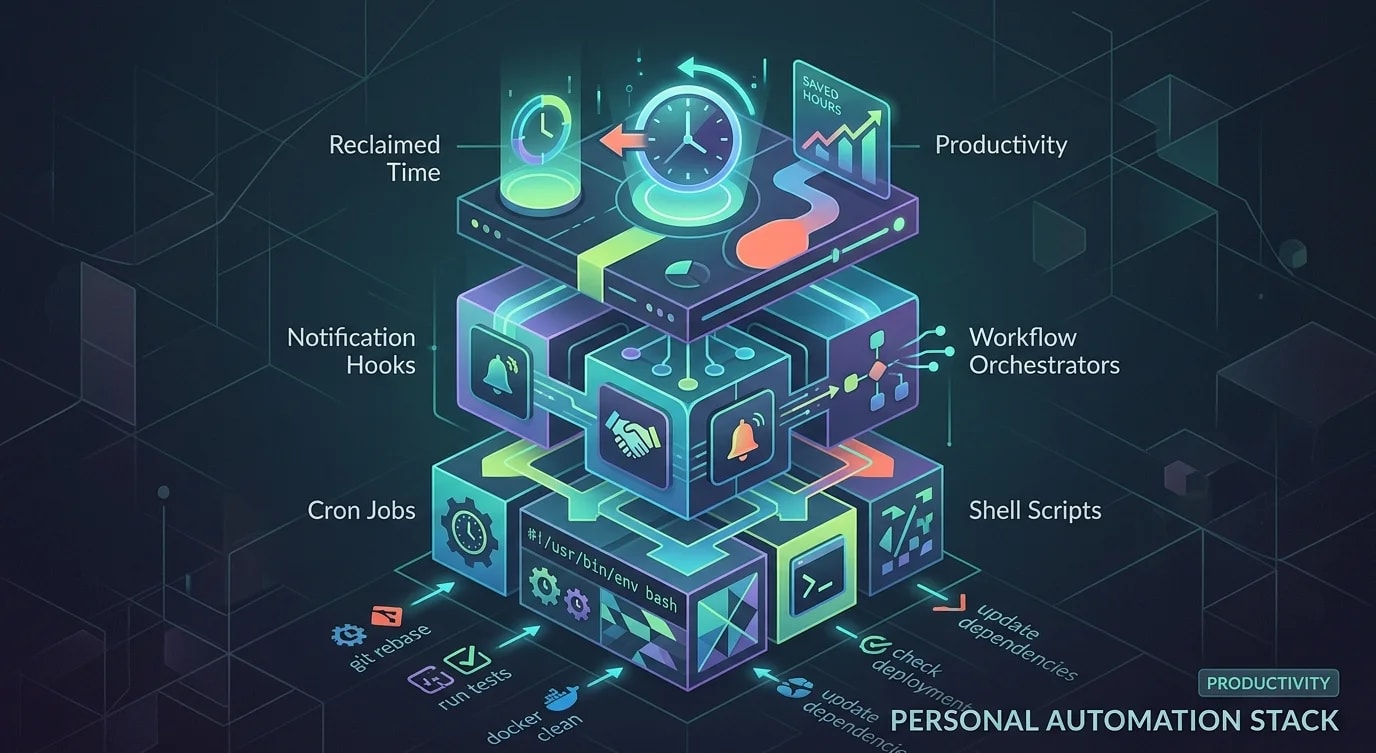
A Productivity System That Scales With Your Career
A practical framework for a developer productivity system that grows with your responsibilities — IC through tech lead — without collapsing under itself.

Why Most Productivity Systems Break
Developers build productivity systems optimized for their current role. The system that works for an individual contributor writing code eight hours a day collapses when that person starts leading a team. Meeting-heavy schedules, context switching between codebases, mentoring sessions, and strategic planning all demand different approaches to time and attention.
The solution is not to find the perfect system—it is to build one that adapts as your responsibilities change.
The Three-Layer Framework
A scalable productivity system operates on three layers: execution (daily), planning (weekly), and strategy (quarterly). Each layer feeds the next, and the balance between them shifts as your role evolves.
// ❌ Flat task list — everything at the same priority level
interface FlatSystem {
  tasks: string[];
  // No distinction between "fix this bug" and "evaluate team hiring plan"
}

// ✅ Layered system — different timeframes, different decision models
interface ProductivitySystem {
  execution: {
    dailyFocus: string[];          // 3-5 concrete tasks
    timeBlocks: TimeBlock[];       // Calendar structure
    energyTracking: EnergyLevel;   // When you do best work
  };
  planning: {
    weeklyGoals: Goal[];           // 2-3 outcomes per week
    reviewCadence: "friday";       // Retrospective
    backlog: PrioritizedItem[];    // Ranked by impact
  };
  strategy: {
    quarterlyThemes: string[];     // What matters most this quarter
    skillInvestments: string[];    // Areas of deliberate growth
    roleAlignment: RoleExpectation[];
  };
}

interface TimeBlock {
  start: string;
  end: string;
  type: "deep-work" | "meetings" | "admin" | "learning";
  flexibility: "fixed" | "movable";
}

interface Goal {
  description: string;
  keyResults: string[];
  status: "not-started" | "in-progress" | "completed" | "blocked";
}
Time Blocking for Different Work Modes
The critical insight is that different types of work require fundamentally different cognitive states. Deep coding work needs uninterrupted blocks of 90+ minutes. Code reviews need focused but shorter blocks. Meetings need prep time before and processing time after.
type WorkMode = "deep" | "shallow" | "collaborative" | "recovery";

interface WorkBlock {
  mode: WorkMode;
  duration: number; // minutes
  tasks: string[];
  prerequisites: string[];
}

function buildDaySchedule(
  role: "ic" | "senior" | "lead" | "manager",
  meetings: Meeting[]
): WorkBlock[] {
  const meetingSlots = meetings.map((m) => ({
    start: m.startTime,
    end: m.endTime,
  }));

  const freeSlots = findFreeSlots(meetingSlots, "09:00", "18:00");

  const blocks: WorkBlock[] = [];

  // Protect the longest free slot for deep work
  const longestSlot = freeSlots.sort(
    (a, b) => slotDuration(b) - slotDuration(a)
  )[0];

  if (longestSlot && slotDuration(longestSlot) >= 90) {
    blocks.push({
      mode: "deep",
      duration: slotDuration(longestSlot),
      tasks: getHighestPriorityDeepWork(role),
      prerequisites: ["notifications-off", "status-dnd"],
    });
  }

  // Batch shallow work into remaining slots
  const shortSlots = freeSlots.filter(
    (s) => slotDuration(s) >= 15 && slotDuration(s) < 90
  );

  for (const slot of shortSlots) {
    blocks.push({
      mode: "shallow",
      duration: slotDuration(slot),
      tasks: getShallowWork(role),
      prerequisites: [],
    });
  }

  // Add recovery blocks after long meetings
  for (const meeting of meetings) {
    if (meeting.duration >= 60) {
      blocks.push({
        mode: "recovery",
        duration: 15,
        tasks: ["process-notes", "update-action-items"],
        prerequisites: [],
      });
    }
  }

  return blocks;
}
Prioritization Across Roles
What counts as "high priority" changes dramatically as you move from IC to lead. An IC prioritizes by code impact. A lead prioritizes by team unblocking. A manager prioritizes by organizational alignment.
interface PrioritizationCriteria {
  role: string;
  factors: Factor[];
}

interface Factor {
  name: string;
  weight: number;
  evaluate: (task: Task) => number;
}

const icPrioritization: PrioritizationCriteria = {
  role: "individual-contributor",
  factors: [
    {
      name: "technical-impact",
      weight: 0.4,
      evaluate: (task) => task.codebaseImpact,
    },
    {
      name: "deadline-proximity",
      weight: 0.3,
      evaluate: (task) => 1 / daysUntilDeadline(task),
    },
    {
      name: "learning-value",
      weight: 0.2,
      evaluate: (task) => task.skillGrowthPotential,
    },
    {
      name: "dependency-chain",
      weight: 0.1,
      evaluate: (task) => task.blockedItems.length,
    },
  ],
};

const leadPrioritization: PrioritizationCriteria = {
  role: "tech-lead",
  factors: [
    {
      name: "team-unblocking",
      weight: 0.35,
      evaluate: (task) => task.teamMembersBlocked,
    },
    {
      name: "strategic-alignment",
      weight: 0.30,
      evaluate: (task) => task.quarterlyGoalAlignment,
    },
    {
      name: "technical-risk",
      weight: 0.20,
      evaluate: (task) => task.riskScore,
    },
    {
      name: "individual-contribution",
      weight: 0.15,
      evaluate: (task) => task.codebaseImpact,
    },
  ],
};

function prioritize(
  tasks: Task[],
  criteria: PrioritizationCriteria
): Task[] {
  return tasks
    .map((task) => ({
      task,
      score: criteria.factors.reduce(
        (total, factor) => total + factor.weight * factor.evaluate(task),
        0
      ),
    }))
    .sort((a, b) => b.score - a.score)
    .map(({ task }) => task);
}
The Weekly Review as System Maintenance
The weekly review is the mechanism that keeps the system from drifting. Without it, daily execution disconnects from weekly goals, which disconnect from quarterly strategy. Fifteen minutes every Friday prevents hours of misaligned effort.
interface WeeklyReview {
  completedGoals: Goal[];
  incompleteGoals: Goal[];
  surprises: string[];
  nextWeekPriorities: string[];
  systemAdjustments: string[];
}

function conductWeeklyReview(
  weekPlan: WeeklyPlan,
  actualOutcomes: Outcome[]
): WeeklyReview {
  const completed = weekPlan.goals.filter(
    (g) => g.status === "completed"
  );
  const incomplete = weekPlan.goals.filter(
    (g) => g.status !== "completed"
  );

  // Identify work that wasn't planned but consumed time
  const unplannedWork = actualOutcomes.filter(
    (o) => !weekPlan.goals.some((g) => g.id === o.goalId)
  );

  const review: WeeklyReview = {
    completedGoals: completed,
    incompleteGoals: incomplete,
    surprises: unplannedWork.map(
      (w) => `${w.description} consumed ${w.hoursSpent}h`
    ),
    nextWeekPriorities: deriveNextWeekPriorities(
      incomplete,
      weekPlan.quarterlyThemes
    ),
    systemAdjustments: [],
  };

  // Detect patterns that need system changes
  if (unplannedWork.length > completed.length) {
    review.systemAdjustments.push(
      "Too much reactive work — add buffer blocks to schedule"
    );
  }

  if (incomplete.length > completed.length) {
    review.systemAdjustments.push(
      "Overcommitting on weekly goals — reduce to 2 per week"
    );
  }

  return review;
}
Scaling the System as Responsibilities Grow
The system adapts through a single principle: as your role expands, shift time from execution to planning, and from planning to strategy. An IC spends 80% executing, 15% planning, 5% strategizing. A tech lead shifts to 50/30/20. A manager moves to 30/30/40.
type RoleLevel = "ic" | "senior" | "lead" | "manager";

const timeAllocation: Record<RoleLevel, {
  execution: number;
  planning: number;
  strategy: number;
}> = {
  ic:      { execution: 0.80, planning: 0.15, strategy: 0.05 },
  senior:  { execution: 0.65, planning: 0.25, strategy: 0.10 },
  lead:    { execution: 0.45, planning: 0.30, strategy: 0.25 },
  manager: { execution: 0.25, planning: 0.35, strategy: 0.40 },
};

function auditTimeAllocation(
  role: RoleLevel,
  actualHours: { execution: number; planning: number; strategy: number }
): string[] {
  const target = timeAllocation[role];
  const total =
    actualHours.execution + actualHours.planning + actualHours.strategy;

  const suggestions: string[] = [];

  const executionRatio = actualHours.execution / total;
  if (executionRatio > target.execution + 0.15) {
    suggestions.push(
      `Spending ${Math.round(executionRatio * 100)}% on execution — ` +
      `target is ${Math.round(target.execution * 100)}%. ` +
      `Delegate or automate some execution work.`
    );
  }

  const strategyRatio = actualHours.strategy / total;
  if (strategyRatio < target.strategy - 0.10) {
    suggestions.push(
      `Only ${Math.round(strategyRatio * 100)}% on strategy — ` +
      `invest more time in quarterly planning and career direction.`
    );
  }

  return suggestions;
}
Key Takeaways
The productivity system that scales is the one built on layers: daily execution, weekly planning, and quarterly strategy. Each layer operates on different decisions and different time horizons. As responsibilities grow, the balance shifts from execution toward strategy—not all at once, but incrementally.
Protect deep work time aggressively. Batch shallow work into short slots. Prioritize differently based on your role—ICs optimize for code impact, leads optimize for team unblocking. Run a weekly review to catch drift between what you planned and what actually happened.
The goal is not to be busy. The goal is to ensure that the time you spend aligns with the outcomes that matter most for your current role.