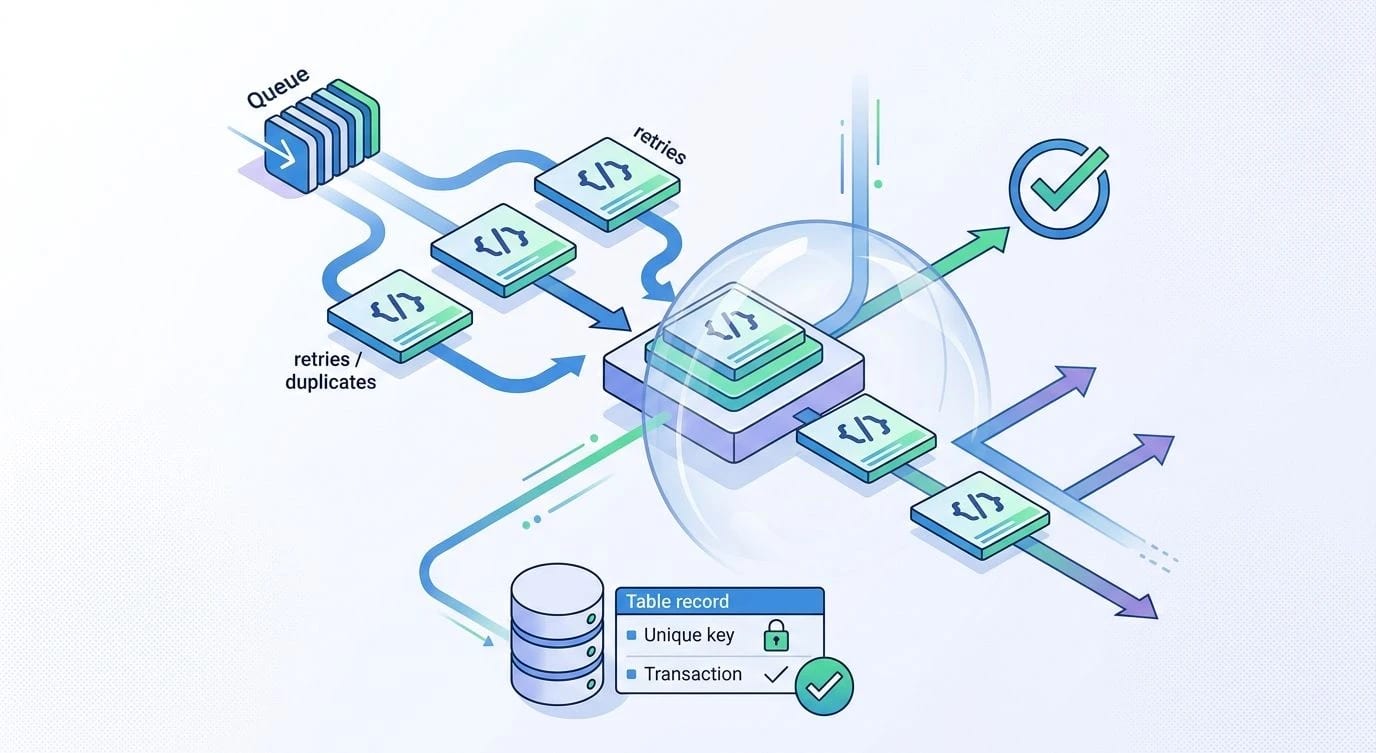
Designing Idempotent Background Jobs: Retries, Locks, and the Exactly-Once Illusion
Exactly-once processing doesn't exist in distributed systems—here's how to design background jobs that survive retries, crashes, and duplicate deliveries anyway.
Tags
32 articles

Exactly-once processing doesn't exist in distributed systems—here's how to design background jobs that survive retries, crashes, and duplicate deliveries anyway.

How to design and implement idempotency keys so retried requests never double-charge, double-send, or double-create resources.

Multi-region failover looks simple on an architecture diagram — the reality involves replication lag, split-brain writes, and DNS caches that refuse to cooperate.

How to add fields, rename properties, and restructure events in async systems without coordinating deployments or silently breaking downstream consumers.

Stop racing conditions in distributed systems: a practical guide to implementing distributed locks with Redis and PostgreSQL advisory locks in Node.js.

Why job queues and database state machines break down for complex multi-step processes, and how durable execution with Temporal gives you workflows that survive crashes, retries, and deployments.

How the transactional outbox pattern eliminates the dual-write problem and guarantees reliable event publishing without coupling your database to your message broker.

Practical lessons from designing and operating microservices at scale — event-driven communication, service boundaries, and the patterns that survived production.

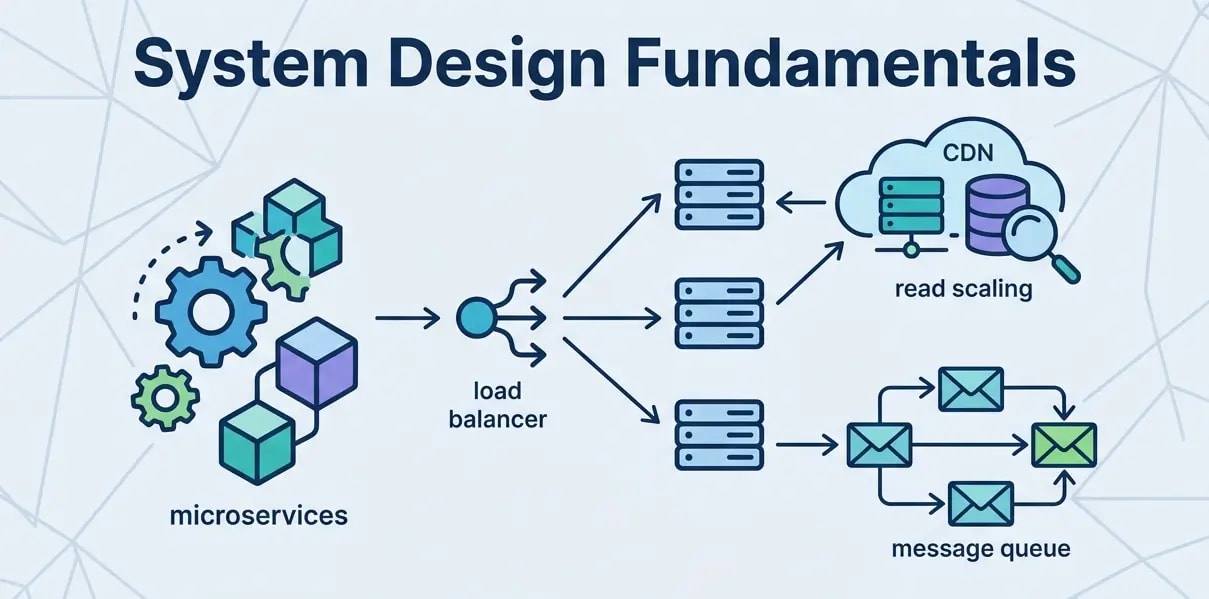
The core concepts behind scalable system design — load balancing, caching, database scaling, queues, and the tradeoffs that guide architectural decisions.

Design scalable WebSocket architectures using connection management, room-based pub/sub, heartbeat mechanisms, reconnection strategies, and horizontal scaling patterns that handle thousands of concurrent connections reliably.

Implement retry policies that recover from transient failures without overwhelming downstream services, using exponential backoff, jitter, circuit breakers, and retry budgets that keep your system stable under degraded conditions.

Practical testing strategies for distributed architectures, covering contract testing between services, chaos engineering for resilience validation, integration test design, and building confidence in systems where end-to-end testing is impractical.

A balanced examination of event sourcing as an architectural pattern covering real-world use cases where it shines, common pitfalls that derail implementations, and practical patterns for event stores and projections.

An exploration of fault tolerance engineering covering circuit breakers, bulkheads, fallback chains, and degradation strategies that keep systems useful when components fail.

Build idempotent API endpoints that handle retries safely using idempotency keys, database constraints, and state machines with TypeScript examples covering payment processing, order creation, and webhook delivery.

Design webhook delivery infrastructure that handles retries with exponential backoff, signature verification, idempotency guarantees, delivery logging, and endpoint health monitoring for reliable event notification.

Design event mesh architectures that route events across multiple clouds and regions with dynamic topic routing, protocol bridging, schema governance, and eventually consistent delivery guarantees.

Master distributed debugging techniques using correlation IDs, distributed tracing context propagation, log aggregation patterns, and causal ordering to trace requests across services and identify root causes.

Design cell-based architectures that isolate failures to small blast radii, enable independent scaling, and prevent cascading outages across distributed systems.

Master distributed caching patterns including cache-aside, write-through, read-through, and cache invalidation strategies that handle real-world consistency challenges.

Explore edge computing patterns that bring computation closer to users, reduce latency, and enable new capabilities for modern web applications and APIs.

Build a production-ready task queue step by step using Node.js and Redis, covering reliable delivery, retries, dead letter queues, and concurrency control.

Explore federated learning concepts, implementation patterns, and practical challenges of training machine learning models across distributed devices while preserving data privacy.

How to implement the saga pattern to manage distributed transactions across microservices — comparing orchestration versus choreography approaches with practical TypeScript examples and compensation logic.

A practical guide to database sharding — covering partitioning strategies, shard key selection, cross-shard queries, and the operational complexity that comes with distributing data.

A practical guide to consensus algorithms — covering Raft, Paxos, and leader election patterns with real-world examples of when and why distributed systems need them.

How to implement timeouts, retries, and backoff strategies that prevent cascading failures in distributed architectures.

A deep dive into rate limiting algorithms with implementations, trade-offs, and guidance on choosing the right approach for your API.

Network failures mean requests are retried — idempotent API design ensures that processing the same request twice produces the same result, preventing duplicate charges and orders.

When a downstream service is failing, continuing to send requests makes everything worse — the circuit breaker pattern stops the cascade by failing fast.

Event-driven systems decouple producers from consumers through asynchronous message passing — but eventual consistency, ordering guarantees, and idempotency introduce real complexity.

RabbitMQ, Redis Streams, or Kafka — understanding the messaging patterns behind decoupled, resilient systems and when each tool fits.