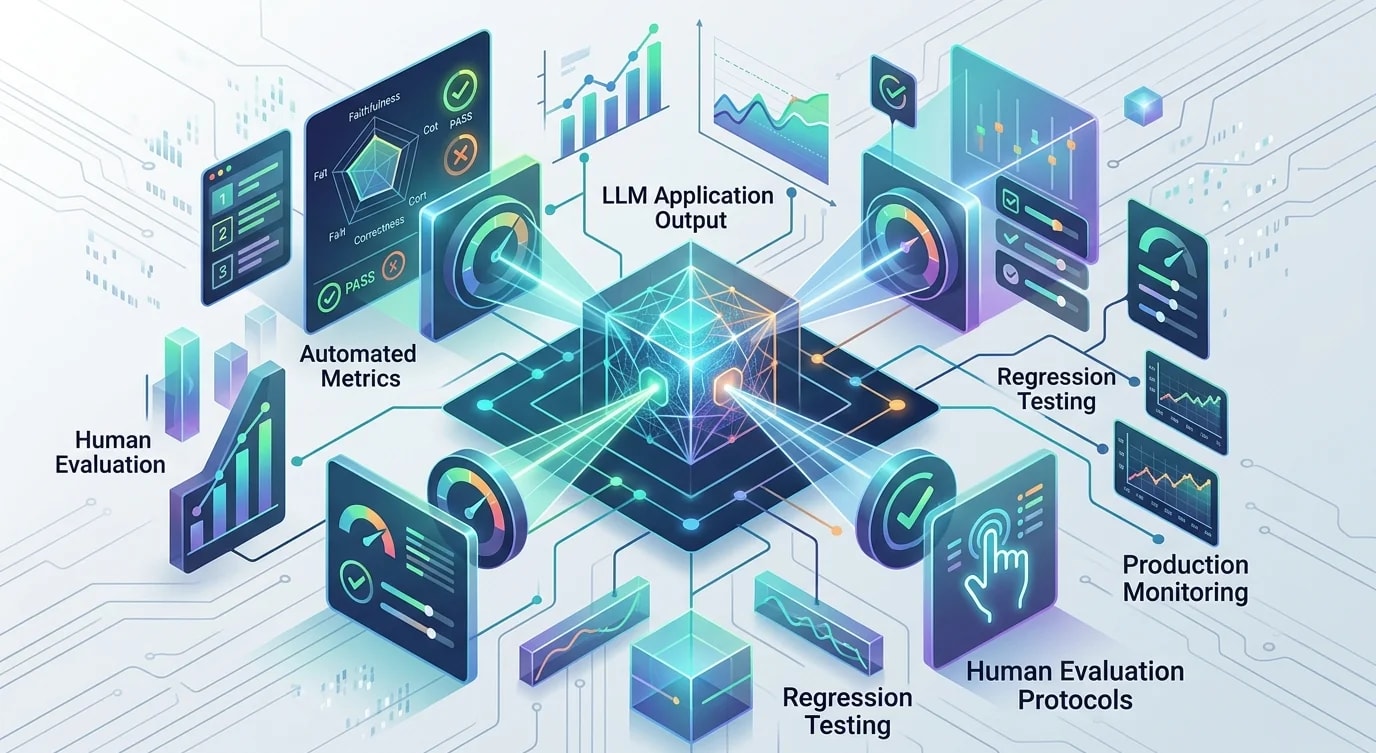
Evaluating LLM Output: Metrics and Testing Frameworks
A practical guide to evaluation pipelines for LLM features: semantic similarity metrics, behavioral testing, regression detection and quality gates.

The LLM Testing Problem
Traditional software testing compares actual output to expected output. If add(2, 3) returns 5, the test passes. LLM outputs are not deterministic, not exact, and not binary in correctness. A summarization model might produce ten different valid summaries for the same input. A code generation model might write functionally correct code that looks nothing like the expected answer.
This means LLM evaluation requires different tools: semantic similarity instead of string equality, behavioral assertions instead of exact output matching, and statistical confidence instead of pass/fail determinism.
Defining Evaluation Metrics
Different LLM tasks require different metrics. A classification task needs accuracy. A summarization task needs faithfulness and coverage. A conversational task needs coherence and relevance.
interface EvalMetric {
  name: string;
  compute: (prediction: string, reference: string, input: string) => Promise<number>;
  threshold: number;
  weight: number;
}

interface EvalResult {
  testCase: string;
  scores: Record<string, number>;
  weightedScore: number;
  passed: boolean;
}

class LLMEvaluator {
  constructor(private readonly metrics: EvalMetric[]) {}

  async evaluate(
    prediction: string,
    reference: string,
    input: string,
    testCaseName: string
  ): Promise<EvalResult> {
    const scores: Record<string, number> = {};
    let weightedSum = 0;
    let totalWeight = 0;

    for (const metric of this.metrics) {
      const score = await metric.compute(prediction, reference, input);
      scores[metric.name] = score;
      weightedSum += score * metric.weight;
      totalWeight += metric.weight;
    }

    const weightedScore = weightedSum / totalWeight;
    const passed = this.metrics.every(
      (m) => scores[m.name] >= m.threshold
    );

    return { testCase: testCaseName, scores, weightedScore, passed };
  }
}
Semantic Similarity Scoring
String comparison fails for LLM evaluation because two semantically identical responses can have completely different wording. Embedding-based similarity captures meaning rather than surface form.
// ❌ String-based comparison — fails for valid paraphrases
function exactMatch(prediction: string, reference: string): boolean {
  return prediction.trim() === reference.trim();
  // "The cat sat on the mat" !== "A cat was sitting atop the mat"
  // Both are valid but this returns false
}

// ✅ Embedding-based semantic similarity
async function cosineSimilarity(
  embedding1: number[],
  embedding2: number[]
): Promise<number> {
  let dotProduct = 0;
  let norm1 = 0;
  let norm2 = 0;

  for (let i = 0; i < embedding1.length; i++) {
    dotProduct += embedding1[i] * embedding2[i];
    norm1 += embedding1[i] ** 2;
    norm2 += embedding2[i] ** 2;
  }

  return dotProduct / (Math.sqrt(norm1) * Math.sqrt(norm2));
}

async function semanticSimilarity(
  prediction: string,
  reference: string,
  embeddingFn: (text: string) => Promise<number[]>
): Promise<number> {
  const [predEmbedding, refEmbedding] = await Promise.all([
    embeddingFn(prediction),
    embeddingFn(reference),
  ]);

  return cosineSimilarity(predEmbedding, refEmbedding);
}
Cosine similarity on embeddings typically returns values between 0.7 and 1.0 for related texts. A threshold of 0.85 works well for paraphrase detection, while 0.75 is appropriate for topical similarity.
Behavioral Testing with Assertions
Instead of checking exact outputs, behavioral tests verify that the LLM output exhibits specific properties. Does the summary mention the key entities? Does the translation preserve numbers? Does the code compile?
interface BehavioralAssertion {
  name: string;
  check: (output: string, input: string) => boolean;
}

const summarizationAssertions: BehavioralAssertion[] = [
  {
    name: "shorter-than-input",
    check: (output, input) => output.length < input.length * 0.5,
  },
  {
    name: "preserves-named-entities",
    check: (output, input) => {
      const entities = extractNamedEntities(input);
      return entities.every((entity) =>
        output.toLowerCase().includes(entity.toLowerCase())
      );
    },
  },
  {
    name: "preserves-numbers",
    check: (output, input) => {
      const inputNumbers = input.match(/\d+\.?\d*/g) || [];
      const criticalNumbers = inputNumbers.filter(
        (n) => parseFloat(n) > 0
      );
      return criticalNumbers.every((n) => output.includes(n));
    },
  },
  {
    name: "no-hallucinated-quotes",
    check: (output, input) => {
      const outputQuotes = output.match(/"[^"]+"/g) || [];
      return outputQuotes.every((quote) => input.includes(quote));
    },
  },
];

function runBehavioralTests(
  output: string,
  input: string,
  assertions: BehavioralAssertion[]
): { passed: string[]; failed: string[] } {
  const passed: string[] = [];
  const failed: string[] = [];

  for (const assertion of assertions) {
    if (assertion.check(output, input)) {
      passed.push(assertion.name);
    } else {
      failed.push(assertion.name);
    }
  }

  return { passed, failed };
}
Building an Evaluation Dataset
A good evaluation dataset captures the distribution of real-world inputs, including edge cases that are likely to cause errors.
interface EvalTestCase {
  id: string;
  input: string;
  expectedOutput: string;
  category: string;
  difficulty: "easy" | "medium" | "hard";
  edgeCaseType?: string;
}

const evaluationDataset: EvalTestCase[] = [
  {
    id: "sum-001",
    input:
      "The company reported Q3 revenue of $4.2 billion, up 15% year-over-year. CEO Jane Smith attributed growth to the cloud division.",
    expectedOutput:
      "Company Q3 revenue reached $4.2B (+15% YoY), driven by cloud growth per CEO Jane Smith.",
    category: "financial-summary",
    difficulty: "easy",
  },
  {
    id: "sum-002",
    input:
      "Despite the 23% increase in active users to 150 million, the platform reported a net loss of $89 million due to increased infrastructure spending. However, the company expects profitability by Q2 next year.",
    expectedOutput:
      "Active users grew 23% to 150M, but infrastructure costs drove $89M net loss. Profitability expected by Q2.",
    category: "financial-summary",
    difficulty: "medium",
    edgeCaseType: "contradictory-signals",
  },
  {
    id: "sum-003",
    input: "",
    expectedOutput: "",
    category: "edge-case",
    difficulty: "easy",
    edgeCaseType: "empty-input",
  },
];

function validateDatasetCoverage(dataset: EvalTestCase[]): {
  categoryDistribution: Record<string, number>;
  difficultyDistribution: Record<string, number>;
  edgeCaseCoverage: string[];
  gaps: string[];
} {
  const categories: Record<string, number> = {};
  const difficulties: Record<string, number> = {};
  const edgeCases: Set<string> = new Set();

  for (const tc of dataset) {
    categories[tc.category] = (categories[tc.category] || 0) + 1;
    difficulties[tc.difficulty] = (difficulties[tc.difficulty] || 0) + 1;
    if (tc.edgeCaseType) edgeCases.add(tc.edgeCaseType);
  }

  const expectedEdgeCases = [
    "empty-input",
    "very-long-input",
    "special-characters",
    "multilingual",
    "contradictory-signals",
  ];
  const gaps = expectedEdgeCases.filter((ec) => !edgeCases.has(ec));

  return {
    categoryDistribution: categories,
    difficultyDistribution: difficulties,
    edgeCaseCoverage: [...edgeCases],
    gaps,
  };
}
Regression Detection Pipeline
When you update a prompt template, fine-tune a model, or change the LLM version, you need to detect regressions before they reach production.
interface RegressionReport {
  baselineVersion: string;
  candidateVersion: string;
  totalTests: number;
  improved: number;
  regressed: number;
  unchanged: number;
  averageScoreChange: number;
  recommendation: "promote" | "investigate" | "reject";
}

async function detectRegressions(
  baseline: EvalResult[],
  candidate: EvalResult[],
  regressionThreshold: number = 0.05
): Promise<RegressionReport> {
  let improved = 0;
  let regressed = 0;
  let unchanged = 0;
  let totalScoreChange = 0;

  for (let i = 0; i < baseline.length; i++) {
    const diff =
      candidate[i].weightedScore - baseline[i].weightedScore;
    totalScoreChange += diff;

    if (diff > regressionThreshold) {
      improved++;
    } else if (diff < -regressionThreshold) {
      regressed++;
    } else {
      unchanged++;
    }
  }

  const avgChange = totalScoreChange / baseline.length;
  const regressionRate = regressed / baseline.length;

  let recommendation: "promote" | "investigate" | "reject";
  if (regressionRate > 0.1) {
    recommendation = "reject";
  } else if (regressionRate > 0.05 || avgChange < 0) {
    recommendation = "investigate";
  } else {
    recommendation = "promote";
  }

  return {
    baselineVersion: "v1.0",
    candidateVersion: "v1.1",
    totalTests: baseline.length,
    improved,
    regressed,
    unchanged,
    averageScoreChange: avgChange,
    recommendation,
  };
}
CI/CD Integration for LLM Quality Gates
LLM evaluation should run as part of the deployment pipeline, blocking releases that fail quality thresholds.
interface QualityGateConfig {
  minPassRate: number;
  minAverageScore: number;
  maxRegressionRate: number;
  criticalTestCases: string[];
}

async function runQualityGate(
  results: EvalResult[],
  config: QualityGateConfig
): Promise<{ passed: boolean; reasons: string[] }> {
  const reasons: string[] = [];

  // Check overall pass rate
  const passRate =
    results.filter((r) => r.passed).length / results.length;
  if (passRate < config.minPassRate) {
    reasons.push(
      `Pass rate ${(passRate * 100).toFixed(1)}% below threshold ${config.minPassRate * 100}%`
    );
  }

  // Check average score
  const avgScore =
    results.reduce((sum, r) => sum + r.weightedScore, 0) /
    results.length;
  if (avgScore < config.minAverageScore) {
    reasons.push(
      `Average score ${avgScore.toFixed(3)} below threshold ${config.minAverageScore}`
    );
  }

  // Check critical test cases
  for (const criticalId of config.criticalTestCases) {
    const result = results.find((r) => r.testCase === criticalId);
    if (result && !result.passed) {
      reasons.push(`Critical test case failed: ${criticalId}`);
    }
  }

  return { passed: reasons.length === 0, reasons };
}
Key Takeaways
LLM evaluation requires fundamentally different approaches than traditional software testing. Use semantic similarity rather than string equality to handle valid paraphrases. Build behavioral assertions that check for specific properties—entity preservation, number accuracy, length constraints—rather than exact output matching.
Maintain evaluation datasets that cover the distribution of real inputs including edge cases. Run regression detection when changing prompts, models, or configurations to catch quality degradation before deployment. Integrate quality gates into CI/CD pipelines so that LLM-powered features receive the same deployment rigor as any other critical feature.
The goal is not perfect scores—it is confidence that changes do not make things worse and visibility into the quality distribution across your test cases.