Patrones de arquitectura de edge computing para aplicaciones web
Patrones de edge computing que acercan el cálculo a los usuarios, reducen la latencia y habilitan nuevas capacidades en aplicaciones web y APIs.
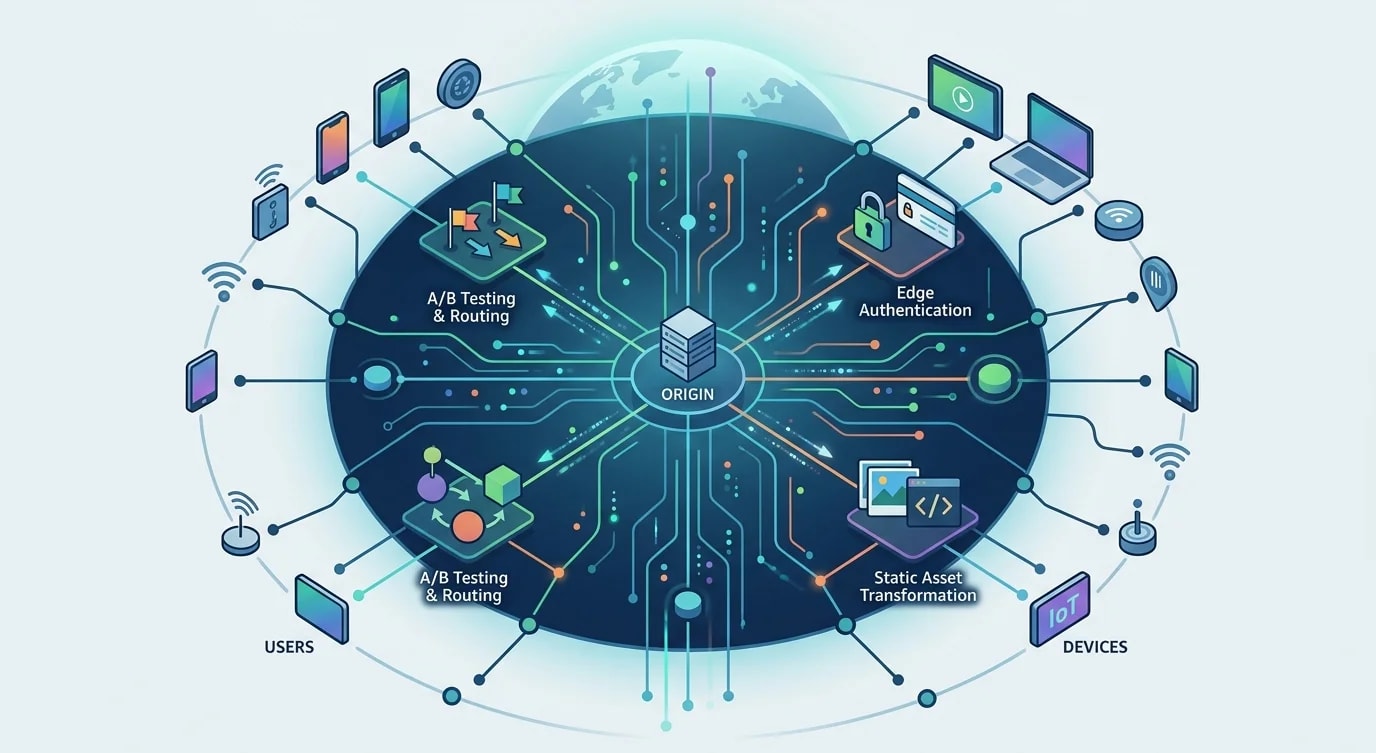
Mover la computación de un centro de datos centralizado al borde de la red no se trata solo de rendimiento: es un cambio fundamental en cómo diseñamos aplicaciones web. Cuando tu código se ejecuta en 300 ubicaciones en todo el mundo en lugar de una, las restricciones y las posibilidades cambian drásticamente.
El edge computing reduce la latencia eliminando los viajes de ida y vuelta a orígenes lejanos. Pero también introduce desafíos que las arquitecturas tradicionales de servidores no enfrentan: tiempo de computo limitado, consistencia eventual entre regiones y penalizaciones por arranque en frío que afectan a usuarios reales.
El espectro del edge computing
No todo pertenece al edge. Comprender el espectro desde full-edge hasta edge-asistido te ayuda a tomar decisiones inteligentes de colocación.
// ❌ Putting everything at the edge without thinking
// Edge functions have time limits, memory limits, and no persistent storage

// ✅ Strategic placement based on data and compute needs
interface WorkloadPlacement {
  location: "edge" | "regional" | "origin";
  rationale: string;
  examples: string[];
}

const placementStrategy: WorkloadPlacement[] = [
  {
    location: "edge",
    rationale: "Stateless, fast, personalization based on request",
    examples: [
      "A/B test routing",
      "Geolocation-based redirects",
      "Auth token validation",
      "Request header manipulation",
      "Static asset transformation",
    ],
  },
  {
    location: "regional",
    rationale: "Needs data access, moderate compute, regional cache",
    examples: [
      "API responses with regional data",
      "Session management",
      "Rate limiting with shared counters",
      "Search with regional indexes",
    ],
  },
  {
    location: "origin",
    rationale: "Heavy compute, global consistency, complex transactions",
    examples: [
      "Payment processing",
      "Database writes with ACID guarantees",
      "ML model inference (large models)",
      "Report generation",
    ],
  },
];
El objetivo no es eliminar el servidor de origen: es manejar tanto como sea posible antes de que la solicitud llegue a él. Piensa en el edge como tu primera línea de procesamiento, no como la única.
Autenticación y autorización en el edge
Validar la autenticación en el edge elimina uno de los viajes de ida y vuelta más comunes. En lugar de reenviar cada solicitud al origen para verificar la autenticación, valida los tokens en milisegundos en el nodo de edge más cercano.
// Edge function: validate JWT before reaching origin
import { jwtVerify, importSPKI } from "jose";

interface EdgeAuthResult {
  authenticated: boolean;
  userId?: string;
  roles?: string[];
  error?: string;
}

// Public key cached at edge (rotated via cron)
const PUBLIC_KEY_PEM = `-----BEGIN PUBLIC KEY-----
MIIBIjANBgkqhk...
-----END PUBLIC KEY-----`;

async function authenticateAtEdge(
  request: Request
): Promise<EdgeAuthResult> {
  const authHeader = request.headers.get("authorization");

  if (!authHeader?.startsWith("Bearer ")) {
    return { authenticated: false, error: "Missing token" };
  }

  const token = authHeader.slice(7);

  try {
    const publicKey = await importSPKI(PUBLIC_KEY_PEM, "RS256");
    const { payload } = await jwtVerify(token, publicKey, {
      issuer: "https://auth.example.com",
      audience: "https://api.example.com",
    });

    return {
      authenticated: true,
      userId: payload.sub,
      roles: payload.roles as string[],
    };
  } catch {
    return { authenticated: false, error: "Invalid token" };
  }
}

// Edge handler
export default async function handler(request: Request): Promise<Response> {
  const auth = await authenticateAtEdge(request);

  if (!auth.authenticated) {
    return new Response(
      JSON.stringify({ error: auth.error }),
      { status: 401, headers: { "Content-Type": "application/json" } }
    );
  }

  // Forward authenticated request to origin with user context
  const originRequest = new Request(request);
  originRequest.headers.set("X-User-Id", auth.userId ?? "");
  originRequest.headers.set("X-User-Roles", (auth.roles ?? []).join(","));

  return fetch(originRequest);
}
Este patrón ahorra 50-200ms por solicitud al evitar el viaje de ida y vuelta al origen para la autenticación. La función de edge valida el JWT usando una clave pública en caché: no se necesita consultar la base de datos. Las solicitudes no autorizadas nunca llegan a tu servidor de origen.
Invalidación inteligente de caché en el edge
El problema más difícil en el cacheo en el edge no es el cacheo: es la invalidación. Datos obsoletos en 300 nodos de edge son peor que no tener caché en absoluto. La invalidación basada en etiquetas proporciona precisión quirúrgica.
// ❌ Cache everything with time-based expiry
// Products page shows stale prices for up to 60 seconds
const headers = new Headers();
headers.set("Cache-Control", "public, max-age=60");

// ✅ Tag-based cache with instant invalidation
interface CacheEntry {
  response: Response;
  tags: string[];
  createdAt: number;
}

class EdgeCache {
  private cache: Map<string, CacheEntry> = new Map();
  private tagIndex: Map<string, Set<string>> = new Map();

  async get(key: string): Promise<Response | null> {
    const entry = this.cache.get(key);
    if (!entry) return null;
    return entry.response.clone();
  }

  async set(
    key: string,
    response: Response,
    tags: string[]
  ): Promise<void> {
    this.cache.set(key, {
      response: response.clone(),
      tags,
      createdAt: Date.now(),
    });

    // Build reverse index: tag → cache keys
    for (const tag of tags) {
      if (!this.tagIndex.has(tag)) {
        this.tagIndex.set(tag, new Set());
      }
      this.tagIndex.get(tag)!.add(key);
    }
  }

  async invalidateByTag(tag: string): Promise<number> {
    const keys = this.tagIndex.get(tag);
    if (!keys) return 0;

    let invalidated = 0;
    for (const key of keys) {
      this.cache.delete(key);
      invalidated++;
    }

    this.tagIndex.delete(tag);
    return invalidated;
  }
}

// Usage in edge handler
const cache = new EdgeCache();

async function handleProductRequest(
  request: Request
): Promise<Response> {
  const url = new URL(request.url);
  const cacheKey = url.pathname;

  const cached = await cache.get(cacheKey);
  if (cached) return cached;

  const response = await fetch(request);

  // Tag with product ID and category for targeted invalidation
  const productId = url.pathname.split("/").pop();
  await cache.set(cacheKey, response, [
    `product:${productId}`,
    "products-list",
    "storefront",
  ]);

  return response;
}

// When a product price changes, invalidate just that product
// await cache.invalidateByTag("product:abc123");
// This purges the product page without touching unrelated cache entries
La invalidación basada en etiquetas significa que puedes actualizar el precio de un producto y purgar instantáneamente solo las respuestas en caché de ese producto en todas las ubicaciones de edge, sin tocar la caché de miles de otros productos.
Personalización en el edge
La personalización típicamente requiere un viaje de ida y vuelta al origen para obtener las preferencias del usuario. Los almacenes clave-valor en el edge permiten la personalización sin la penalización de latencia.
// Edge personalization without origin round trip
interface UserPreferences {
  language: string;
  currency: string;
  theme: "light" | "dark";
  region: string;
}

async function personalizeAtEdge(
  request: Request,
  kvStore: KVNamespace
): Promise<Response> {
  const userId = request.headers.get("X-User-Id");
  const geo = request.headers.get("CF-IPCountry") ?? "US";

  let preferences: UserPreferences;

  if (userId) {
    // Fetch user preferences from edge KV
    const stored = await kvStore.get(`prefs:${userId}`, "json");
    preferences = (stored as UserPreferences) ?? getDefaultPreferences(geo);
  } else {
    preferences = getDefaultPreferences(geo);
  }

  // Fetch the page from origin
  const originResponse = await fetch(request);
  const html = await originResponse.text();

  // Inject personalization at the edge
  const personalized = html
    .replace("{{LANG}}", preferences.language)
    .replace("{{CURRENCY}}", preferences.currency)
    .replace("{{THEME}}", preferences.theme);

  return new Response(personalized, {
    headers: {
      ...Object.fromEntries(originResponse.headers),
      "Content-Type": "text/html",
      "Vary": "X-User-Id",
    },
  });
}

function getDefaultPreferences(countryCode: string): UserPreferences {
  const regionMap: Record<string, Partial<UserPreferences>> = {
    US: { language: "en", currency: "USD" },
    GB: { language: "en", currency: "GBP" },
    DE: { language: "de", currency: "EUR" },
    JP: { language: "ja", currency: "JPY" },
  };

  return {
    language: "en",
    currency: "USD",
    theme: "light",
    region: countryCode,
    ...regionMap[countryCode],
  };
}

interface KVNamespace {
  get(key: string, type: "json"): Promise<unknown>;
}
Los almacenes KV en el edge típicamente tienen latencia de lectura submilisegundo en el edge. La compensación es la consistencia eventual: un cambio de preferencia puede tardar segundos en propagarse a todas las ubicaciones de edge. Para la personalización, esto suele ser aceptable.
Manejo de las limitaciones de las funciones de edge
Las funciones de edge se ejecutan en entornos restringidos. Entender los límites te ayuda a diseñar dentro de ellos en lugar de luchar contra ellos.
// Common edge function constraints and workarounds

// ❌ Long-running computation at the edge
async function generateReport(data: unknown[]): Promise<Response> {
  // This will hit the 10-50ms CPU time limit on most edge platforms
  const report = heavyComputation(data); // Times out!
  return new Response(report);
}

// ✅ Delegate heavy work, respond immediately
async function smartEdgeHandler(request: Request): Promise<Response> {
  const url = new URL(request.url);

  // Fast decisions at the edge
  if (url.pathname === "/api/status") {
    return new Response(JSON.stringify({ status: "ok" }), {
      headers: { "Content-Type": "application/json" },
    });
  }

  // Geolocation routing
  const country = request.headers.get("CF-IPCountry") ?? "US";
  const regionOrigin = getRegionalOrigin(country);

  // Transform and forward to nearest regional server
  const modifiedRequest = new Request(regionOrigin + url.pathname, {
    method: request.method,
    headers: request.headers,
    body: request.body,
  });

  return fetch(modifiedRequest);
}

function getRegionalOrigin(country: string): string {
  const regions: Record<string, string> = {
    US: "https://us-east.api.example.com",
    CA: "https://us-east.api.example.com",
    GB: "https://eu-west.api.example.com",
    DE: "https://eu-west.api.example.com",
    JP: "https://ap-northeast.api.example.com",
    AU: "https://ap-southeast.api.example.com",
  };
  return regions[country] ?? regions.US;
}
Conclusiones clave
El edge computing no se trata de reemplazar tus servidores: se trata de ampliarlos con una capa distribuida globalmente que maneje el trabajo que más se beneficia de la proximidad a los usuarios. La autenticación, la personalización, las decisiones de caché y el enrutamiento geográfico mejoran drásticamente cuando se ejecutan en el edge.
Las arquitecturas de edge más exitosas siguen un principio simple: haz todo lo posible con los datos que ya tienes en el edge, y solo regresa al origen cuando realmente lo necesites. Cada viaje de ida y vuelta al origen que eliminas son 50-300ms ahorrados para un usuario real en algún lugar del mundo.