Effektive technische RFCs und Design-Dokumente schreiben
Schreibe RFCs und Design-Dokumente, die Entscheidungen vorantreiben: strukturiert um Kompromisse, geprüfte Alternativen und messbare Kriterien.
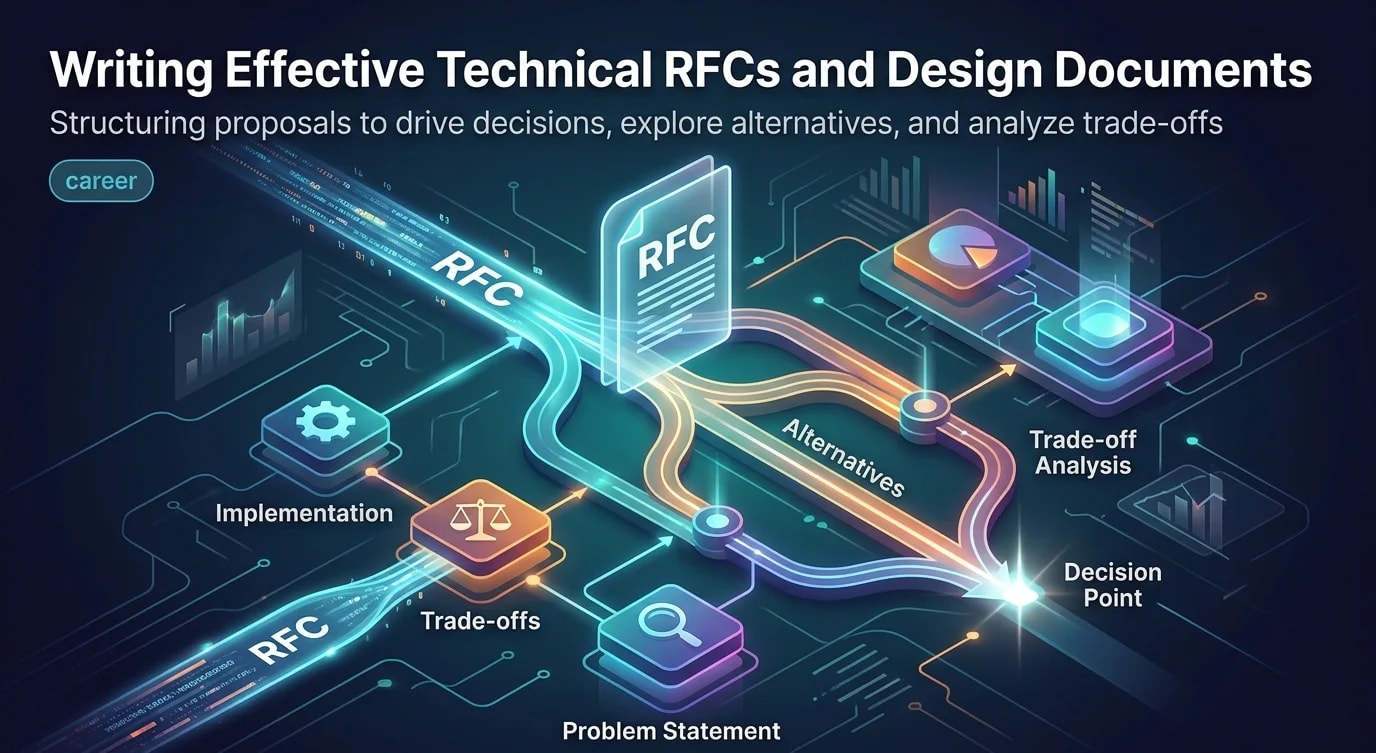
Die meisten Design-Dokumente scheitern, bevor sie überhaupt jemand liest. Entweder sind sie zu lang – 40-seitige Spezifikationen, für die niemand Zeit hat – oder zu vage – ein Absatz voller Allgemeinplätze, der eigentlich nichts Konkretes vorschlägt. Die schlimmsten beschreiben eine Lösung, ohne das Problem zu erklären, und zwingen die Gutachter zu raten, ob der Ansatz zu Rahmenbedingungen passt, die sie nur erahnen können.
Ein wirksames RFC tut genau eines: Es hilft einer Gruppe von Ingenieuren, eine gut informierte Entscheidung zu treffen. Alles im Dokument sollte diesem Ziel dienen. Wenn ein Abschnitt niemandem hilft zu entscheiden, ob der Vorschlag angenommen, geändert oder abgelehnt wird, hat er darin nichts verloren.
Die minimal tragfähige RFC-Struktur
Jedes RFC braucht genau fünf Abschnitte. Alles andere ist optional. Wenn du diese fünf Abschnitte nicht füllen kannst, verstehst du das Problem noch nicht gut genug, um eine Lösung vorzuschlagen.
# RFC: [Short descriptive title]

## Status
- **Author**: [Name]
- **Reviewers**: [Names — people whose input you need]
- **Status**: Draft | In Review | Approved | Rejected | Superseded
- **Date**: [Created date]
- **Decision deadline**: [When this must be decided by]

## Problem Statement
What problem are we solving? Who has this problem?
Why does it matter now?

[2-4 paragraphs, no solution details here]

## Proposed Solution
How do we solve it? Be specific enough that someone
could implement this without talking to you.

[Technical details, diagrams, interface definitions]

## Alternatives Considered
What other approaches did you evaluate? Why were they
rejected? This is the most important section — it shows
you've actually explored the design space.

[At least 2 alternatives with honest trade-off analysis]

## Trade-offs and Risks
What are we giving up? What could go wrong? What
assumptions might be wrong?

[Honest assessment of downsides]
Die Problemstellung formulieren
An der Problemstellung entscheidet sich meist, ob ein RFC gelingt oder scheitert. Eine klare Problemstellung schreibt den Rest des Dokuments fast von selbst. Eine vage Problemstellung führt zu endlosen Diskussionen über die Lösung, weil die Leser in Wirklichkeit über das Problem streiten.
## ❌ Bad problem statement

"We need to improve our authentication system. The current
system is old and doesn't scale. We should use OAuth 2.0."

Problems:
- Mixes problem and solution ("We should use OAuth 2.0")
- "Old and doesn't scale" — what specifically doesn't scale?
- No data or evidence
- No impact statement

## ✅ Good problem statement

"Our session-based auth system creates two problems as we
scale to multiple regions:

1. **Session stickiness breaks multi-region failover.**
   Sessions are stored in-memory on the origin server. When
   we fail over to another region, all users are logged out.
   We've had 3 incidents in Q3 where failover caused a spike
   of 40,000 simultaneous re-authentication requests that
   overwhelmed the auth database.

2. **Third-party integrations require per-integration auth
   code.** Each of our 12 integration partners requires
   custom authentication middleware. Adding a new partner
   takes 2-3 weeks of engineering time, primarily spent on
   auth plumbing rather than business logic.

Our SLA requires 99.9% availability across regions, and our
roadmap includes 8 new integration partners in the next two
quarters. Both goals are blocked by the current auth
architecture."
Geprüfte Alternativen: der am meisten unterschätzte Abschnitt
Gutachter vertrauen einem Vorschlag mehr, wenn erkennbar ist, dass du den Lösungsraum wirklich durchdacht hast. Alternativen sind keine Füllmasse – sie sind der Beleg für fundiertes technisches Urteilsvermögen.
## Alternatives Considered

### Alternative A: Migrate sessions to Redis cluster
Store sessions in a Redis cluster replicated across regions.

**Pros:**
- Minimal application code changes
- Team already operates Redis
- Session data remains mutable

**Cons:**
- Cross-region Redis replication adds 50-100ms latency
- Redis cluster adds operational complexity
  (split-brain risks)
- Doesn't solve the third-party integration problem

**Why rejected:** Solves problem #1 partially (failover works
but with added latency) and doesn't address problem #2 at all.

### Alternative B: JWT tokens with no session store
Stateless JWTs eliminate the session store entirely.

**Pros:**
- No session storage to manage
- Naturally works across regions
- Verification is a local operation

**Cons:**
- Revocation is complex (requires blocklist)
- Token size increases with claims
- Cannot invalidate tokens before expiry without
  additional infrastructure

**Why rejected:** Revocation complexity is a dealbreaker for
our security requirements (we need instant session
termination for compromised accounts).

### Proposed: OAuth 2.0 with short-lived access tokens
and refresh token rotation
[Details in Proposed Solution section]

**Why this over the alternatives:** Addresses both problems,
revocation works via refresh token invalidation, and standard
protocol means integration partners use off-the-shelf
libraries.
Diagramme, die wirklich helfen
Ein gut platziertes Diagramm ersetzt ganze Textabsätze. Ein schlecht gezeichnetes Diagramm stiftet dagegen mehr Verwirrung, als es Klarheit schafft.
## Diagram best practices

### Include diagrams for:
- System architecture (what talks to what)
- Request flow (step-by-step sequence)
- Data model relationships
- State machines

### Skip diagrams for:
- Obvious relationships that text explains clearly
- Decorative purposes
- Things that will change before implementation

### Format:
- Use Mermaid, PlantUML, or Excalidraw
  (version-controllable, editable by reviewers)
- Label every arrow (what data flows, what protocol)
- Include a legend if using symbols
- Keep to one concept per diagram// Anti-pattern: implementation details that don't
// help the decision
// ❌ Don't include in the RFC:
// - Exact variable names and function signatures
// - Database column types
// - CSS class names
// - Test file structures
// ✅ Do include:
// - API contracts (what the interface looks like)
// - Data flow between systems
// - Key algorithms or approaches (pseudocode is fine)
// - Performance characteristics (Big O, expected latency)
// Example: API contract in an RFC
interface AuthAPI {
// Token endpoint — called by clients to authenticate
'POST /auth/token': {
request: { grant_type: string; code?: string; refresh_token?: string };
response: { access_token: string; refresh_token: string; expires_in: number };
};
// Revocation — called to invalidate a session
'POST /auth/revoke': {
request: { token: string };
response: { revoked: boolean };
};
// Introspection — called by services to validate tokens
'POST /auth/introspect': {
request: { token: string };
response: { active: boolean; sub: string; exp: number; scope: string };
};
}Erfolgskriterien und Rollback-Pläne
Ein RFC ohne Erfolgskriterien lässt sich nach der Umsetzung nie bewerten. Lege von vornherein fest, wie „fertig" und „funktionsfähig" aussehen.
## Success Criteria

### Functional:
- [ ] Multi-region failover completes without logging
      out users
- [ ] New integration partner can authenticate in <3 days
      of engineering work (down from 2-3 weeks)
- [ ] Session revocation takes effect within 5 minutes

### Performance:
- [ ] Auth endpoint P99 latency < 200ms (current: 150ms)
- [ ] Token validation < 5ms per request (local operation)
- [ ] No increase in auth-related error rate

### Operational:
- [ ] Auth system operates independently in each region
- [ ] Monitoring and alerting configured before rollout
- [ ] Runbook for common failure scenarios documented

## Rollback Plan
If the migration causes issues:
1. **Immediate (< 1 hour):** Feature flag to route traffic
   back to session-based auth
2. **Short-term (< 1 week):** Dual-write to both session
   store and token system during migration
3. **Reversal condition:** Rollback if auth error rate
   exceeds 0.5% or P99 latency exceeds 500ms for
   more than 10 minutes
Den Review-Prozess durchführen
Das Dokument ist nur die halbe Miete. Der Review-Prozess entscheidet darüber, ob tatsächlich Entscheidungen getroffen werden.
## RFC review process

### Before sharing:
- Get informal feedback from 1-2 people
  (catch obvious issues before the formal review)
- Make sure the problem statement is solid
  (reviewers will nit-pick solutions; they'll reject
  unclear problems)

### Review meeting structure (60 min max):
1. Author presents problem statement only (10 min)
2. Group validates: "Is this the right problem?" (10 min)
3. Author presents proposed solution (15 min)
4. Group discusses trade-offs and alternatives (20 min)
5. Decision: approve / request changes / reject (5 min)

### Common review anti-patterns:
- "Let me redesign the whole thing" → Time-box feedback
- "What about edge case X?" → Great, file it as a follow-up
- No decision after review → Set a decision deadline
- "I need more time" → OK, but the deadline doesn't move

### Decision modes:
- **Consensus**: everyone agrees (ideal but slow)
- **Consent**: nobody objects (faster, usually good enough)
- **Authority**: designated decision-maker decides
  (fastest, use for time-sensitive decisions)
Die wichtigsten Erkenntnisse
Jedes RFC braucht genau fünf Abschnitte – Problemstellung, vorgeschlagene Lösung, geprüfte Alternativen, Kompromisse und Erfolgskriterien – und wenn du nicht alle fünf füllen kannst, verstehst du das Problem noch nicht gut genug, um eine Lösung vorzuschlagen. Die Problemstellung ist der wichtigste Abschnitt: Beziffere die Auswirkungen mit Daten (Vorfälle, verlorene Ingenieurstunden, SLA-Verstöße), trenne das Problem vollständig von der Lösung und erkläre, warum es gerade jetzt wichtig ist – eine klare Problemstellung macht die Lösung fast selbstverständlich, während eine vage Problemstellung endlose Diskussionen garantiert. Der Abschnitt „geprüfte Alternativen" schafft Vertrauen bei den Gutachtern, weil er zeigt, dass du den Lösungsraum wirklich durchdacht hast – nimm mindestens zwei echte Alternativen mit einer ehrlichen Abwägung ihrer Vor- und Nachteile auf und erkläre konkret, warum jede verworfen wurde. Lege vor Beginn der Umsetzung explizite Erfolgskriterien mit messbaren Zielwerten fest, füge einen konkreten Rollback-Plan mit Auslösebedingungen bei und führe Reviews als zeitlich begrenzte Entscheidungen mit einer Frist durch – ein RFC, das nie zu einer Entscheidung führt, ist schlimmer als gar kein RFC.


