Retrospectivas de sprint efectivas que impulsan una mejora real
Supera las retrospectivas superficiales con formatos estructurados, resultados accionables y un seguimiento que convierte el feedback en cambios.
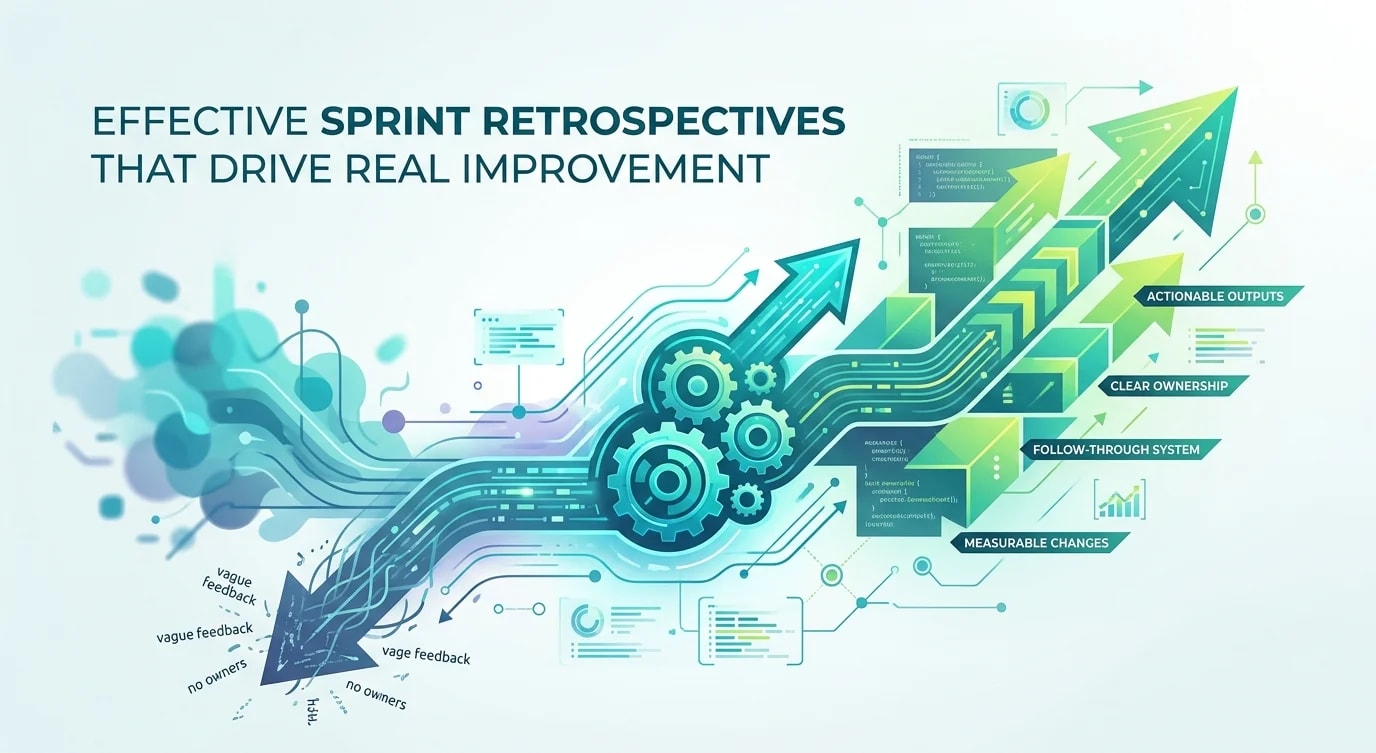
La mayoría de las retrospectivas de sprint son una pérdida de tiempo. El equipo enumera qué salió bien, qué salió mal y genera elementos de acción que nadie da seguimiento. Dos semanas después, los mismos problemas aparecen en el mismo formato de retro, y todos se preguntan por qué nada cambia.
Las retrospectivas efectivas requieren tres cosas que la mayoría de los equipos omiten: facilitación estructurada que saque a la luz problemas reales, elementos de acción específicos con responsable, y un sistema de seguimiento que garantice el cumplimiento.
Por qué fallan los formatos de retro estándar
El formato "Qué salió bien / Qué no / Elementos de acción" falla porque es demasiado abierto. La gente recurre a observaciones seguras y superficiales que no impulsan cambios.
// ❌ Typical retro output: vague and unactionable
interface BadRetroOutput {
  wentWell: string[];
  wentPoorly: string[];
  actionItems: string[];
}

const typicalRetro: BadRetroOutput = {
  wentWell: [
    "Good teamwork",
    "Delivered on time",
    "Communication was better",
  ],
  wentPoorly: [
    "Too many meetings",
    "Deploy process is slow",
    "Requirements keep changing",
  ],
  actionItems: [
    "Reduce meetings",          // Who? By when? How?
    "Improve deploy process",   // What specifically?
    "Better requirement docs",  // Whose responsibility?
  ],
};// ✅ Structured retro output: specific and trackable
interface ActionItem {
description: string;
owner: string;
dueDate: string;
successCriteria: string;
status: "not-started" | "in-progress" | "completed" | "dropped";
}
interface StructuredRetroOutput {
theme: string;
insights: {
observation: string;
impact: "high" | "medium" | "low";
evidence: string;
}[];
actions: ActionItem[];
previousActionsReview: {
action: string;
status: string;
outcome: string;
}[];
}
const effectiveRetro: StructuredRetroOutput = {
theme: "Deploy pipeline reliability",
insights: [
{
observation: "Deploy failures blocked 3 PRs for 2+ hours each this sprint",
impact: "high",
evidence: "CI logs show 7 failed deploys, 3 required manual intervention",
},
],
actions: [
{
description: "Add deploy smoke test that runs health check on staging",
owner: "Sarah",
dueDate: "2023-03-20",
successCriteria: "Zero manual rollbacks needed in next sprint",
status: "not-started",
},
],
previousActionsReview: [
{
action: "Add Slack alerts for failed CI runs",
status: "completed",
outcome: "Reduced response time from 45min to 5min average",
},
],
};Cada elemento de acción necesita un responsable, una fecha límite y criterios de éxito. Sin estos, "mejorar el proceso de despliegue" significa algo distinto para cada uno y nadie asume la responsabilidad.
Formatos de facilitación que sacan a la luz problemas reales
Diferentes formatos funcionan para diferentes situaciones. Rotar los formatos previene la fatiga de retrospectivas y saca a relucir distintos tipos de ideas.
interface RetroFormat {
  name: string;
  bestFor: string;
  duration: number; // minutes
  phases: {
    name: string;
    duration: number;
    instructions: string;
  }[];
}

const formats: RetroFormat[] = [
  {
    name: "Timeline Retro",
    bestFor: "Complex sprints with many events worth discussing",
    duration: 60,
    phases: [
      {
        name: "Build the timeline",
        duration: 10,
        instructions:
          "Everyone adds events to a shared timeline. " +
          "Include deploys, incidents, meetings, breakthroughs.",
      },
      {
        name: "Mark energy levels",
        duration: 5,
        instructions:
          "Each person draws their energy curve over the sprint. " +
          "Where were you energized? Drained?",
      },
      {
        name: "Identify patterns",
        duration: 15,
        instructions:
          "Group discussion: which events cluster together? " +
          "What caused the energy dips?",
      },
      {
        name: "Generate actions",
        duration: 15,
        instructions:
          "For the top 2 patterns, brainstorm specific fixes. " +
          "Dot vote to prioritize.",
      },
      {
        name: "Assign and commit",
        duration: 10,
        instructions:
          "Top-voted actions get owners, deadlines, and success criteria.",
      },
    ],
  },
  {
    name: "Four Ls",
    bestFor: "Teams new to retros or needing a broader perspective",
    duration: 45,
    phases: [
      {
        name: "Liked",
        duration: 5,
        instructions: "What did you enjoy or appreciate this sprint?",
      },
      {
        name: "Learned",
        duration: 5,
        instructions: "What new knowledge or skills did you gain?",
      },
      {
        name: "Lacked",
        duration: 5,
        instructions: "What was missing? Information, tools, support?",
      },
      {
        name: "Longed for",
        duration: 5,
        instructions: "What do you wish you had? What would make work better?",
      },
      {
        name: "Discuss and prioritize",
        duration: 15,
        instructions: "Group similar items, dot vote top issues, generate actions.",
      },
      {
        name: "Commit",
        duration: 10,
        instructions: "Assign owners and deadlines for top-voted actions.",
      },
    ],
  },
];
El principio clave en todos los formatos: divergir primero (todos generan ideas de forma independiente) y luego converger (discusión grupal y priorización). Esto evita que las voces más fuertes dominen y saca a la luz perspectivas que los miembros más callados del equipo tienen.
El sistema de seguimiento de elementos de acción
El sistema de seguimiento es lo que separa a las retrospectivas que impulsan cambios de las que generan notas adhesivas olvidadas. Revisa los elementos de acción anteriores antes de generar otros nuevos.
class RetroTracker {
  private actions: ActionItem[] = [];
  private history: StructuredRetroOutput[] = [];

  addRetro(retro: StructuredRetroOutput): void {
    this.history.push(retro);
    this.actions.push(...retro.actions);
  }

  getOpenActions(): ActionItem[] {
    return this.actions.filter(
      a => a.status === "not-started" || a.status === "in-progress"
    );
  }

  getCompletionRate(sprintsBack: number = 5): number {
    const recent = this.history.slice(-sprintsBack);
    const allActions = recent.flatMap(r => r.actions);

    if (allActions.length === 0) return 0;

    const completed = allActions.filter(
      a => a.status === "completed"
    ).length;

    return completed / allActions.length;
  }

  getRecurringThemes(): Map<string, number> {
    const themes = new Map<string, number>();

    for (const retro of this.history) {
      for (const insight of retro.insights) {
        const normalized = insight.observation
          .toLowerCase()
          .replace(/[^a-z\s]/g, "");

        // Simple keyword extraction
        const keywords = normalized
          .split(" ")
          .filter(w => w.length > 4);

        for (const keyword of keywords) {
          themes.set(keyword, (themes.get(keyword) ?? 0) + 1);
        }
      }
    }

    return new Map(
      [...themes.entries()]
        .filter(([, count]) => count >= 3)
        .sort((a, b) => b[1] - a[1])
    );
  }

  generateHealthReport(): {
    actionCompletionRate: number;
    openActionCount: number;
    overdueCount: number;
    recurringThemes: string[];
  } {
    const now = new Date();
    const open = this.getOpenActions();
    const overdue = open.filter(
      a => new Date(a.dueDate) < now
    );
    const themes = this.getRecurringThemes();

    return {
      actionCompletionRate: this.getCompletionRate(),
      openActionCount: open.length,
      overdueCount: overdue.length,
      recurringThemes: [...themes.keys()].slice(0, 5),
    };
  }
}
Si la tasa de cumplimiento cae por debajo del 70 %, el equipo está generando más acciones de las que puede manejar. Reduce la cantidad de elementos de acción por retrospectiva: dos acciones bien ejecutadas superan a cinco abandonadas.
Manejo de dinámicas difíciles en retrospectivas
Todo equipo tiene dinámicas que socavan la discusión honesta: la persona que domina, la que se queda callada, el manager cuya presencia impide la franqueza.
interface FacilitationTechnique {
  problem: string;
  technique: string;
  implementation: string;
}

const techniques: FacilitationTechnique[] = [
  {
    problem: "One person dominates discussion",
    technique: "Round-robin with time limit",
    implementation:
      "Each person speaks for exactly 2 minutes in rotation. " +
      "Use a visible timer. No interruptions allowed.",
  },
  {
    problem: "People hold back honest feedback",
    technique: "Anonymous digital input",
    implementation:
      "Use a tool like Miro or FunRetro for the divergent phase. " +
      "Everyone writes anonymously before group discussion.",
  },
  {
    problem: "Same issues every sprint, no progress",
    technique: "Five Whys on a recurring theme",
    implementation:
      "Pick the most recurring issue. Ask 'why' five times to find " +
      "the root cause. Often the surface complaint masks a deeper " +
      "systemic issue the team can actually fix.",
  },
  {
    problem: "Action items never get done",
    technique: "Action item budget",
    implementation:
      "Maximum 2 action items per retro. Must be completable within " +
      "one sprint. If previous actions aren't done, discuss why before " +
      "adding new ones.",
  },
  {
    problem: "Retros feel performative, not genuine",
    technique: "Rotate facilitator",
    implementation:
      "Different person facilitates each sprint. Provides fresh " +
      "perspective and distributes ownership of the process.",
  },
];
Conectar las retrospectivas con resultados medibles
La prueba definitiva de una práctica de retrospectivas es si las métricas de entrega del equipo mejoran con el tiempo. Rastrea la conexión entre las acciones de la retrospectiva y sus resultados.
interface RetroImpactMetric {
  metric: string;
  beforeRetroAction: number;
  afterRetroAction: number;
  linkedAction: string;
  sprintsToImprove: number;
}

function assessRetroImpact(
  metrics: RetroImpactMetric[]
): {
  totalImprovements: number;
  avgTimeToImprove: number;
  biggestWin: RetroImpactMetric | null;
} {
  const improvements = metrics.filter(
    m => m.afterRetroAction > m.beforeRetroAction
  );

  const avgTime =
    improvements.length > 0
      ? improvements.reduce((s, m) => s + m.sprintsToImprove, 0) /
        improvements.length
      : 0;

  const biggestWin = improvements.reduce<RetroImpactMetric | null>(
    (best, current) => {
      const currentDelta =
        current.afterRetroAction - current.beforeRetroAction;
      const bestDelta = best
        ? best.afterRetroAction - best.beforeRetroAction
        : 0;
      return currentDelta > bestDelta ? current : best;
    },
    null
  );

  return {
    totalImprovements: improvements.length,
    avgTimeToImprove: Math.round(avgTime * 10) / 10,
    biggestWin,
  };
}

// Example usage
const impact = assessRetroImpact([
  {
    metric: "Deploy success rate",
    beforeRetroAction: 0.72,
    afterRetroAction: 0.95,
    linkedAction: "Added smoke tests to deploy pipeline",
    sprintsToImprove: 2,
  },
  {
    metric: "PR review turnaround (hours)",
    beforeRetroAction: 48,
    afterRetroAction: 12,
    linkedAction: "Added daily review slot from 10-11am",
    sprintsToImprove: 1,
  },
]);
Puntos clave
La diferencia entre retrospectivas útiles e inútiles se reduce a la disciplina de ejecución, no a la innovación de formatos. Comienza cada retrospectiva revisando los elementos de acción de la anterior: esto crea responsabilidad y deja ver qué está bloqueando realmente el cambio. Limita los elementos de acción a dos por sprint y asegúrate de que cada uno tenga un responsable, una fecha límite y criterios de éxito. Rastrea las tasas de cumplimiento y los temas recurrentes para detectar cuándo el equipo está dando vueltas sin avanzar.
Los mejores facilitadores de retrospectivas saben que el formato importa menos que la seguridad para hablar con honestidad. Rota los facilitadores, usa entrada anónima para temas sensibles y demuestra que la retroalimentación genera cambios reales. Cuando los miembros del equipo ven que su sugerencia del sprint anterior se implementó de verdad, traen mejores ideas al siguiente sprint.


