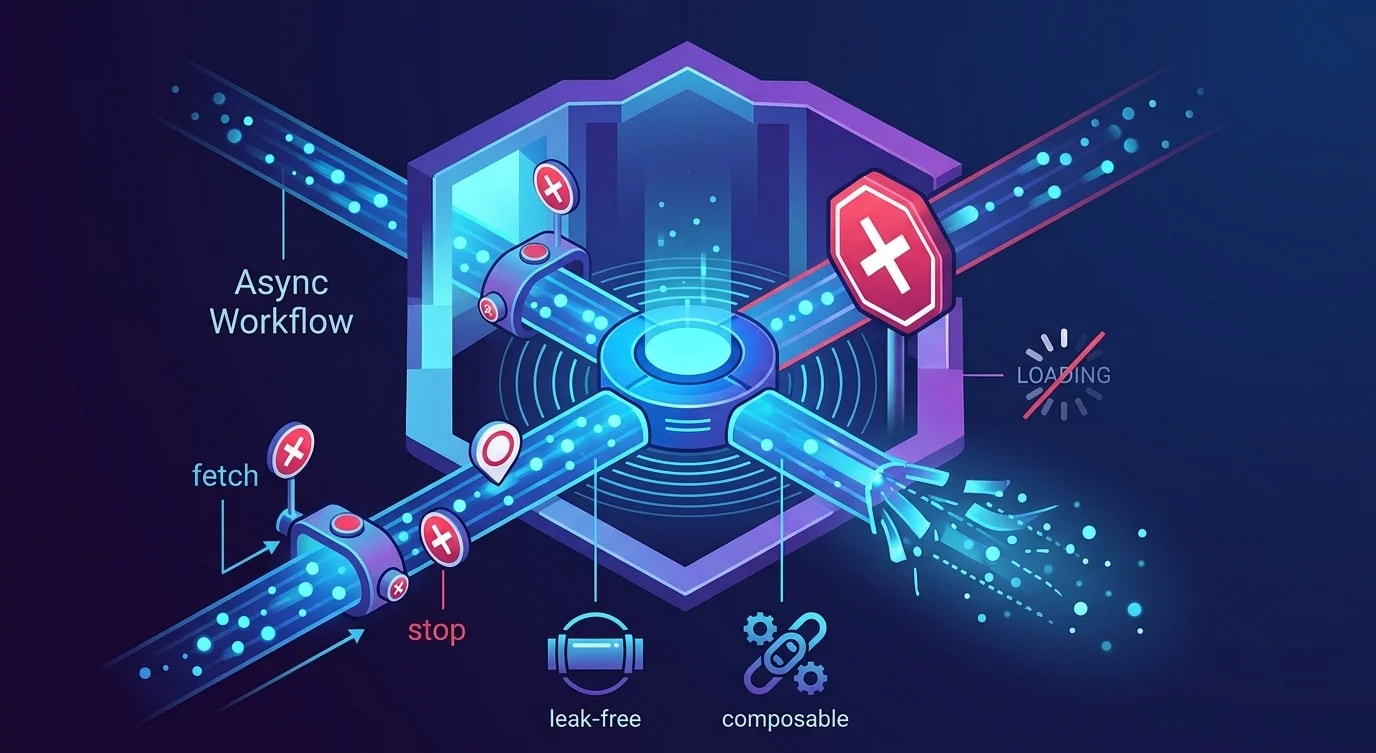
Patrones de iteración asíncrona en JavaScript y TypeScript
Iteradores y generadores asíncronos en JavaScript a fondo: bucles for-await-of, funciones generadoras, backpressure y patrones de streaming reales.

Los iteradores síncronos transformaron la forma en que JavaScript maneja las colecciones. Los iteradores asíncronos extienden el mismo patrón a fuentes de datos asíncronas: APIs paginadas, cursores de bases de datos, streams de archivos, mensajes WebSocket y colas de eventos. En lugar de cargar todo en memoria de una vez, procesas los elementos uno a uno a medida que van estando disponibles.
El bucle for-await-of es para los datos asíncronos lo que for-of es para los datos síncronos: una forma limpia y legible de consumir valores de una fuente que los entrega a lo largo del tiempo.
El protocolo de iterador asíncrono
Un iterador asíncrono implementa el protocolo Symbol.asyncIterator. Devuelve un objeto con un método next() que retorna una Promise que se resuelve en { value, done }.
// The protocol in TypeScript terms
interface AsyncIterator<T> {
  next(): Promise<IteratorResult<T>>;
  return?(): Promise<IteratorResult<T>>;
  throw?(e: unknown): Promise<IteratorResult<T>>;
}

interface AsyncIterable<T> {
  [Symbol.asyncIterator](): AsyncIterator<T>;
}

// Manual implementation — paginated API client
class PaginatedFetcher implements AsyncIterable<Record<string, unknown>[]> {
  constructor(
    private baseUrl: string,
    private pageSize: number = 50
  ) {}

  [Symbol.asyncIterator](): AsyncIterator<Record<string, unknown>[]> {
    let page = 1;
    let hasMore = true;
    const { baseUrl, pageSize } = this;

    return {
      async next() {
        if (!hasMore) {
          return { value: undefined, done: true };
        }

        const url = `${baseUrl}?page=${page}&limit=${pageSize}`;
        const response = await fetch(url);
        const data = await response.json();

        page++;
        hasMore = data.items.length === pageSize;

        return { value: data.items, done: false };
      },
    };
  }
}

// Clean consumption with for-await-of
async function processAllUsers() {
  const users = new PaginatedFetcher('https://api.example.com/users', 50);

  for await (const batch of users) {
    for (const user of batch) {
      await processUser(user);
    }
  }
  // Automatically stops when API returns fewer items than pageSize
}
Funciones generadoras asíncronas
Los generadores asíncronos combinan la sintaxis de async y function*. Son la forma más sencilla de crear iterables asíncronos: haces yield de valores y el consumidor los recibe a través de for-await-of.
// ❌ Callback-based approach — nested, hard to compose
function fetchAllPages(
  url: string,
  callback: (items: unknown[]) => void,
  done: () => void
) {
  let page = 1;
  function fetchNext() {
    fetch(`${url}?page=${page}`)
      .then((r) => r.json())
      .then((data) => {
        callback(data.items);
        if (data.hasMore) {
          page++;
          fetchNext();
        } else {
          done();
        }
      });
  }
  fetchNext();
}

// ✅ Async generator — flat, composable, readable
async function* fetchAllPages(url: string, pageSize = 50) {
  let page = 1;
  let hasMore = true;

  while (hasMore) {
    const response = await fetch(`${url}?page=${page}&limit=${pageSize}`);
    const data = await response.json();

    yield* data.items; // Yield each item individually
    hasMore = data.items.length === pageSize;
    page++;
  }
}

// Consume directly
for await (const user of fetchAllPages('https://api.example.com/users')) {
  console.log(user.name);
}
El generador se pausa en cada yield hasta que el consumidor está listo para el siguiente valor. Esto crea un backpressure natural: nunca solicitas la página siguiente hasta que has terminado de procesar la actual.
Composición de iteradores asíncronos
El verdadero poder de los iteradores asíncronos está en la composición. Puedes encadenar operaciones de transformación como .map() y .filter(), pero para los iterables asíncronos las implementas como funciones generadoras.
// Utility: async map
async function* asyncMap<T, U>(
  source: AsyncIterable<T>,
  transform: (item: T) => U | Promise<U>
): AsyncGenerator<U> {
  for await (const item of source) {
    yield await transform(item);
  }
}

// Utility: async filter
async function* asyncFilter<T>(
  source: AsyncIterable<T>,
  predicate: (item: T) => boolean | Promise<boolean>
): AsyncGenerator<T> {
  for await (const item of source) {
    if (await predicate(item)) {
      yield item;
    }
  }
}

// Utility: async take (limit number of items)
async function* asyncTake<T>(
  source: AsyncIterable<T>,
  limit: number
): AsyncGenerator<T> {
  let count = 0;
  for await (const item of source) {
    if (count >= limit) return;
    yield item;
    count++;
  }
}

// Utility: async batch (group items into fixed-size chunks)
async function* asyncBatch<T>(
  source: AsyncIterable<T>,
  size: number
): AsyncGenerator<T[]> {
  let batch: T[] = [];
  for await (const item of source) {
    batch.push(item);
    if (batch.length === size) {
      yield batch;
      batch = [];
    }
  }
  if (batch.length > 0) {
    yield batch;
  }
}// Compose into a processing pipeline
async function processActiveUsers() {
const allUsers = fetchAllPages('https://api.example.com/users');
// Pipeline: fetch → filter active → transform → batch → insert
const activeUsers = asyncFilter(allUsers, (u: any) => u.isActive);
const enriched = asyncMap(activeUsers, async (u: any) => ({
...u,
lastSeen: await fetchLastActivity(u.id),
}));
const batches = asyncBatch(enriched, 100);
for await (const batch of batches) {
await bulkInsertToDatabase(batch);
console.log(`Inserted ${batch.length} users`);
}
}
// Each stage processes one item at a time
// Memory usage stays constant regardless of total user countManejo de errores y limpieza
Los iteradores asíncronos admiten los métodos return() y throw() para la limpieza cuando la iteración termina antes de tiempo, ya sea por break, return o una excepción.
async function* databaseCursor(query: string): AsyncGenerator<Record<string, unknown>> {
  const connection = await getConnection();
  const cursor = await connection.query(query);

  try {
    while (cursor.hasNext()) {
      yield await cursor.next();
    }
  } finally {
    // Cleanup runs whether iteration completes normally,
    // breaks early, or throws an error
    await cursor.close();
    await connection.release();
    console.log('Database cursor and connection cleaned up');
  }
}

// All of these trigger the finally block:

// 1. Normal completion
for await (const row of databaseCursor('SELECT * FROM users')) {
  processRow(row);
}
// finally runs after last row

// 2. Early break
for await (const row of databaseCursor('SELECT * FROM users')) {
  if (row.id === targetId) break; // finally runs immediately
}

// 3. Exception
try {
  for await (const row of databaseCursor('SELECT * FROM users')) {
    throw new Error('Processing failed'); // finally runs before catch
  }
} catch (err) {
  console.error(err);
}// ❌ No cleanup — connection and cursor leak on early exit
async function* leakyGenerator(query: string) {
const conn = await getConnection();
const cursor = await conn.query(query);
while (cursor.hasNext()) {
yield await cursor.next();
}
// If consumer breaks early, these never run:
await cursor.close();
await conn.release();
}
// ✅ Always use try/finally in generators that acquire resources
async function* safeGenerator(query: string) {
const conn = await getConnection();
const cursor = await conn.query(query);
try {
while (cursor.hasNext()) {
yield await cursor.next();
}
} finally {
await cursor.close();
await conn.release();
}
}Patrón del mundo real: streaming de archivos grandes
Los iteradores asíncronos son ideales para procesar archivos que no caben en memoria. Los streams legibles de Node.js implementan el protocolo de iterable asíncrono.
import { createReadStream } from 'fs';
import { createInterface } from 'readline';

// Process a multi-gigabyte log file line by line
async function* readLines(filePath: string): AsyncGenerator<string> {
  const stream = createReadStream(filePath, { encoding: 'utf-8' });
  const rl = createInterface({ input: stream, crlfDelay: Infinity });

  for await (const line of rl) {
    yield line;
  }
}

// Compose: read → parse → filter → aggregate
async function analyzeErrorLogs(logPath: string) {
  const lines = readLines(logPath);
  const errors = asyncFilter(lines, (line: string) => line.includes('ERROR'));
  const parsed = asyncMap(errors, (line: string) => {
    const match = line.match(/\[(\d{4}-\d{2}-\d{2})\] ERROR: (.+)/);
    return match ? { date: match[1], message: match[2] } : null;
  });
  const validErrors = asyncFilter(parsed, (e): e is NonNullable<typeof e> => e !== null);

  const errorCounts = new Map<string, number>();
  for await (const error of validErrors) {
    const count = errorCounts.get(error.message) ?? 0;
    errorCounts.set(error.message, count + 1);
  }

  return errorCounts;
  // Processes gigabytes of logs with constant memory usage
}
Conclusiones clave
- Los iteradores asíncronos extienden el protocolo de iterador a fuentes de datos asíncronas: APIs paginadas, cursores de bases de datos, streams de archivos y colas de eventos
- Los generadores asíncronos (
async function*) son la forma más sencilla de crear iterables asíncronos:yieldse pausa hasta que el consumidor solicita el siguiente valor - La composición mediante utilidades generadoras (
asyncMap,asyncFilter,asyncBatch) construye pipelines de procesamiento legibles con uso de memoria constante - Usa siempre
try/finallyen los generadores que adquieren recursos: el bloquefinallyse ejecuta conbreak,returny excepciones lanzadas - El backpressure está integrado: los productores esperan en cada
yieldhasta que los consumidores están listos, evitando la sobrecarga de memoria - Los streams legibles de Node.js son iterables asíncronos:
for await (const chunk of stream)funciona sin configuración adicional